

My Claude Code Origin Story
The inside story of Claude Code, and how a tool I kept at a distance became the one I now find hard to work without.

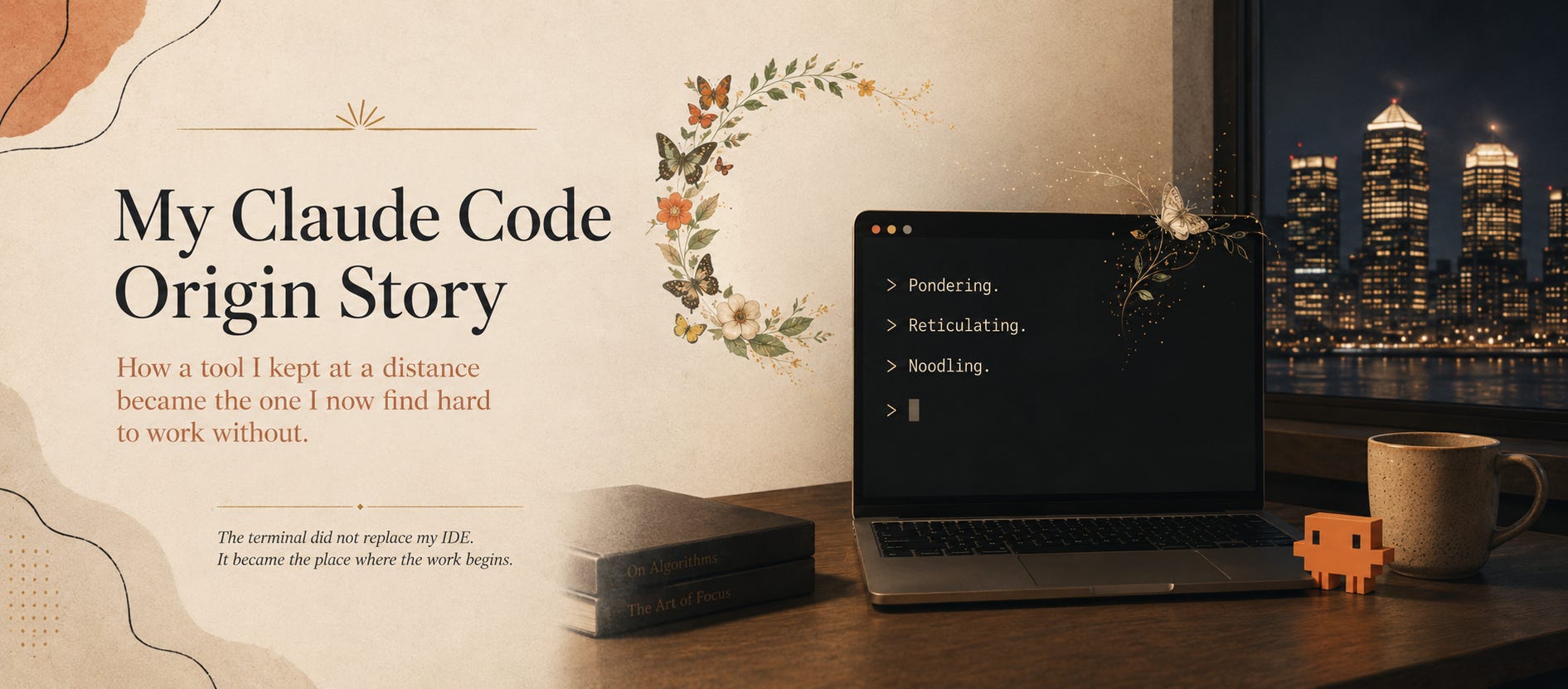
It is a Tuesday evening in Canary Wharf, and my terminal is thinking.
The office is emptying around me after a long day. Notebooks slide into bags. Water bottles click shut. Coffee mugs make a last trip across the desks. I am finishing a pull request review; the diffs are checked, and Claude Code is working through the final points. The cursor sits beside a single word that changes every few seconds. Pondering. Then Reticulating. Then Noodling, which makes me smile every time. Inside the window, an agent is walking through a codebase I know well, reading files I would have opened one by one, running tests I would have run by hand.
Around me, everyone is going home.
I am not typing.
I am watching a word.
Nineteen years of building software trained me to trust serious tools when they looked serious. Integrated development environments. Debuggers. Dashboards. Test runners. Panels arranged with purpose. The familiar furniture of engineering.
This thing announces itself with a verb. A slightly absurd verb in a black window, ticking away while real work happens underneath.
Somebody, somewhere, decided that a machine doing serious work should still make you smile while it does it.
This week, Anthropic published The Making of Claude Code, an oral history told by the researchers, engineers, designers, and early users who built it. I read it once for the facts. Then I read it again for the feeling.
Their story starts in the terminal and grows outward. Mine starts everywhere else and slowly collapses into the terminal.
Both end in the same black window.
The side door
I should have been an easy user for Claude Code.
I was already using AI-assisted development. GitHub Copilot had pulled more of my work into VS Code. I was comfortable asking models to explain code, generate scripts, review changes, and remove little pieces of friction from the day.
But Claude Code had one problem. It lived in the terminal.
I understood terminals. I used them every day. But I thought of the terminal as the place around the work. Build commands, Git operations, package installs, the occasional rescue mission when something broke badly enough. The actual coding happened somewhere else. For years, that place had been IntelliJ. Then VS Code. The editor was the cockpit. The terminal was the engine room.
So when people started talking about Claude Code, I understood the excitement, but I kept my distance. I had spent too many years earning my way into rich tooling to believe the future would arrive as a command-line tool.
Then, on 4 November, an email from the Claude Team landed in my inbox.
“Limited time: $250 in free credits for Claude Code on the web.”
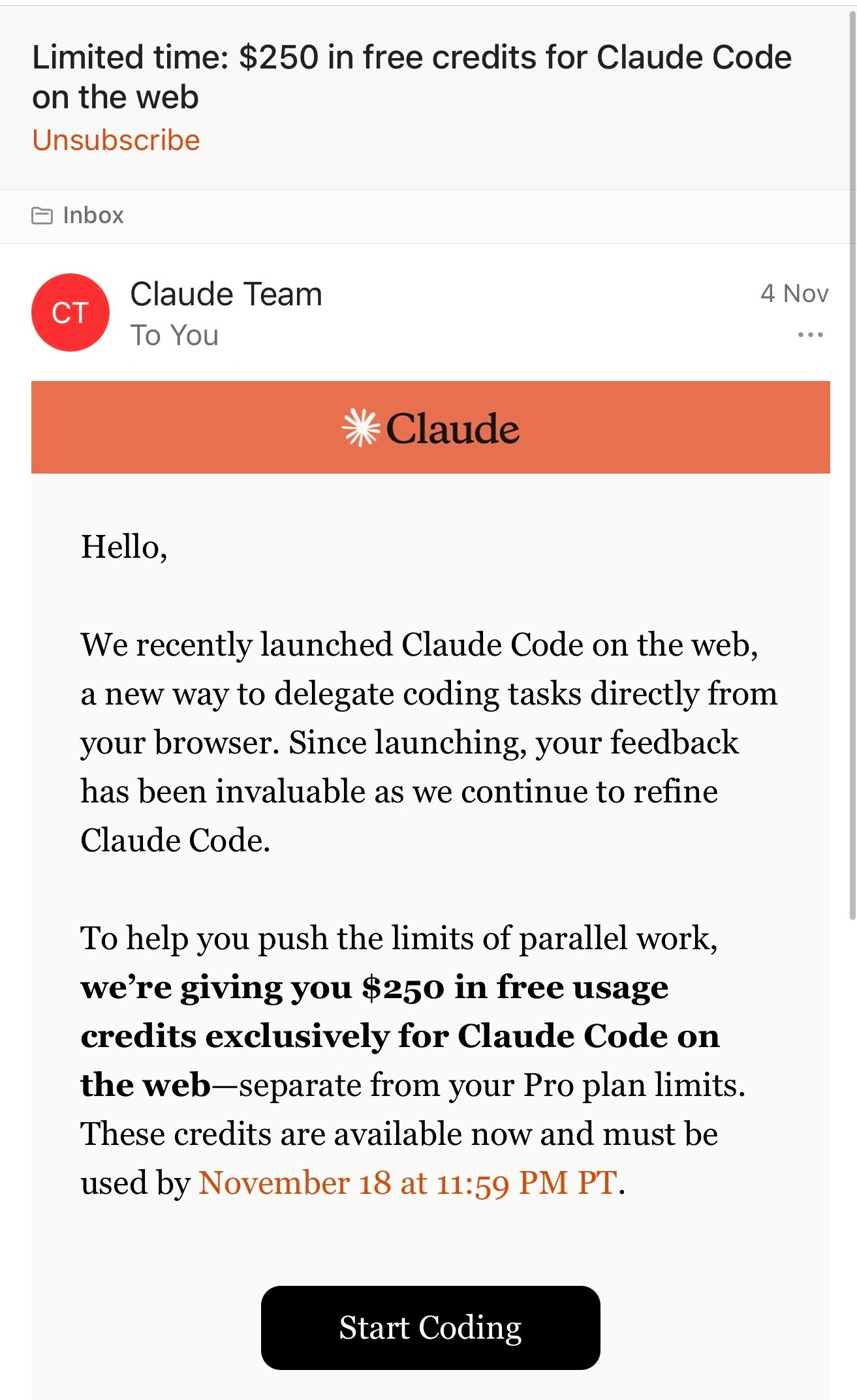
The offer was specific. Claude Code on the web. Free usage credits, separate from my Pro plan limits, available until November 18. At the bottom, a black button: Start Coding.
That was the side door I needed. Free credits. Browser interface. No terminal commitment. I could try the thing without accepting its strongest premise.
So I opened Claude Code on the web and connected a GitHub repository.
There was Clawd, the small character moving through the interface while a machine somewhere spun up my repository and started working through a task. In most serious software, personality is polished away until only utility remains. Here, someone had let it stay.
It gave Claude Code a body.
I gave it a small task. Then a slightly larger one. I created a few GitHub repositories just to see what would happen. I did not even use all the credits. There was no cinematic conversion moment.
The web version lowered the friction. Clawd lowered my guard.
The tool before the tool
Anthropic’s story begins much earlier than I expected, with a research conviction rather than a product idea.
As far back as 2021 and 2022, people inside Anthropic were treating software engineering as the critical path for transformative AI. Dawn Drain spent her first three years there on one goal: make a model that codes as well as she does. Shauna Kravec, who came from theoretical physics, helped build the original reinforcement learning codebase for coding agents. The early results were humbling. Models that could barely write a function. Kravec says the infrastructure problems they hit in 2022 are the same ones the whole industry is wrestling with now.
They were solving 2026’s problems in 2022.
Out of that work came an internal command-line tool called clide. It was slow to start, full of incantations, useful before it was elegant. But people kept reaching for it. Dawn Drain had a clide feature that fanned out a hundred Claude Haikus in parallel to answer questions about an entire folder, and colleagues in pairing sessions kept asking her how she knew about these tools.
New categories often appear this way: a slightly inconvenient thing a few people cannot stop using.
Two moments from the oral history stayed with me.
The first belongs to Adam Wolff, a film major who read the first issue of Wired in 1993, moved to the Bay Area, and eventually helped build React at Facebook. He added an early agentic feature to clide. The first time it worked, he was dancing around his kitchen.
The second belongs to Boris Cherny. He had written a pull request by hand, and Adam rejected it, telling him to use clide instead. Boris copied the issue into clide, and it wrote the whole request. Five or ten lines. He had never seen anything like it. He describes clide as bad software that was still magical, because it saw the future.
A rejected PR was his conversion. A colleague saying, in effect, you are doing this the old way.
I read that part twice. Every convert in this story needed a push that arrived in a form they could not argue with. His was a rejected pull request. Mine, months later, would be an email with a black button.
The demo that got three likes
In September 2024, Boris joined Anthropic Labs with a starter project that sounded almost impossibly broad: automate coding. He wanted to start small, maybe a linter. Ben Mann, the Anthropic co-founder running Labs, pushed him towards the bigger thing.
So Boris spent two days hacking together a demo he called Claude CLI. It was not obviously a coding product. One early demo involved asking what music was playing; the tool screenshotted Apple Music and read the answer.
He posted it on Slack.
It got two or three likes.
That detail stayed with me. The tool that would later change how many engineers work first appeared as a small demo almost nobody noticed: a Slack post with a few thumbs up.
The next day, Boris walked past a colleague’s desk and saw red and green diff lines on the screen. Robert Boyce had pointed the demo at real work. It was doing his coding.
The primitives were there: read, edit, run, observe, try again.
That loop is the centre of Claude Code. The magic is in the cycle. The agent moves through the codebase, the environment responds, and the developer keeps steering.
The team stayed small in the early days. Boris kept asking for engineers; his managers held back growth. In hindsight, the constraint reads like part of the strategy. A small team could ship fixes in minutes, and it forced them to lean on Claude itself. Claude Code was built, in large part, by Claude Code.
There is a line from Ben Mann that explains the deeper bet. In AI products, you sometimes have to build something that works 20 or 30 percent of the time now, because when the next model arrives, it may work 80 percent of the time.
Claude Code launched as a research preview in February 2025, renamed from Claude CLI. The early access feedback had been lukewarm. It was buggy. They launched anyway.
The night before launch, Igor Kofman stayed up making an ASCII logo with Claude, because it would be a small delight at login. Designer Meaghan Choi added Clawd to the terminal. The character I met in my browser months later came from a handful of people putting joy into a launch while nobody was looking.
Then the Claude 4 models arrived, subscriptions arrived with them, and the bet started to pay off. Boris says he went from 10 percent of his code written by Claude Code in February 2025 to 100 percent by winter. Not a single line by hand.
The terminal becomes the app
My own conversion happened later, and slower.
The web version opened the door, but the command-line version changed the room. When Claude Code became available in my day-to-day work, I decided to push myself properly. No browser safety. Real work, real codebase, real terminal.
At first, my resistance was still there. The terminal felt too narrow, too linear. I was used to the editor giving software its shape. Files on the left. Code in the centre. Problems below. Everything visible.
Then I started using Claude Code in full-screen mode.
That changed the feel of the tool. The terminal stopped behaving like a small utility living inside my workflow. It became the workflow. A focused working surface with the task, the plan, the diffs, the commands, the failures, and the next attempt all in one place.
No panels competing for attention. No constant switching. Just the work and the loop.
Then the smaller details began to matter. Slash commands gave structure to repeated interactions. /btw let me ask a side question without interrupting the main session, like leaning over to a colleague while a build is still running. A status line made the interface feel personal. The .claude folder became a quiet layer of project memory. Skills turned repeated rituals into something I could reuse.
The product started to feel less like a tool I opened and more like a workspace I inhabited.
The inversion
One day I noticed the centre had moved.
For years, the IDE had been where the work began. IntelliJ first. Then VS Code, especially once Copilot made the editor feel like the natural home for AI-assisted coding. Now Claude Code in the terminal was where I started. Open a task. Ask for a plan. Let it inspect the codebase. Watch the tests run. Review the diff. Adjust. Ask the next question.
The IDE was still there, but its job had changed. I still used it to read code deeply, inspect larger sections, compare details.
It had become the reading room. The workshop had moved to the terminal.
Claude Code did not make the IDE irrelevant. It changed what I expected the IDE to be for. The place where I once went to create became the place I went to inspect.
A strange lightness
The more I use Claude Code, the more I think its taste matters.
The verbs. The ASCII logo. Clawd. The focused interface. The small pieces of delight that make serious work feel lighter without making it feel unserious.
Taste is not decoration when you live inside a tool for hours. A powerful tool can still feel heavy. A correct tool can still feel hostile. Claude Code has capability. It also has a strange lightness.
That lightness is what carried a terminal tool across the gap for someone like me.
The verb stops
The word changes one more time and stops.
The task is done. Tests green. Diff ready. A short summary waiting for review.
The oral history ends with Boris pointing at an IBM 029 keypunch, similar to the machine his grandfather programmed in the Soviet Union, then tracing the line forward through the first text editors, evolving and evolving, until somewhere on that spectrum sits Claude Code. Igor Kofman remembers debugging his mother’s punch cards as a boy in Ukraine. He no longer writes any code by himself.
I sit in Canary Wharf and think about my own spectrum.
A research effort in 2021.
A clunky internal tool called clide.
A two-day demo that got three likes.
An email with $250 of credits and a button that said Start Coding.
A small character moving through space.
A reluctant IDE-first engineer opening the side door.
A terminal slowly becoming the place where the work begins.
I did not enter through the purest version of the tool. I entered through the least resistant one. The head start mattered more than the perfect entry. Once I was inside, I could go deeper.
And then one day, without ceremony, my habits had changed.
The cockpit is still there.
But my hands keep returning to the terminal.
The terminal did not replace my IDE. It became the place where the work begins.