
Part I: The Spark
Chapter 2: The People Who Walked Away
Before OpenAI had a model, it had people willing to interrupt their own futures.
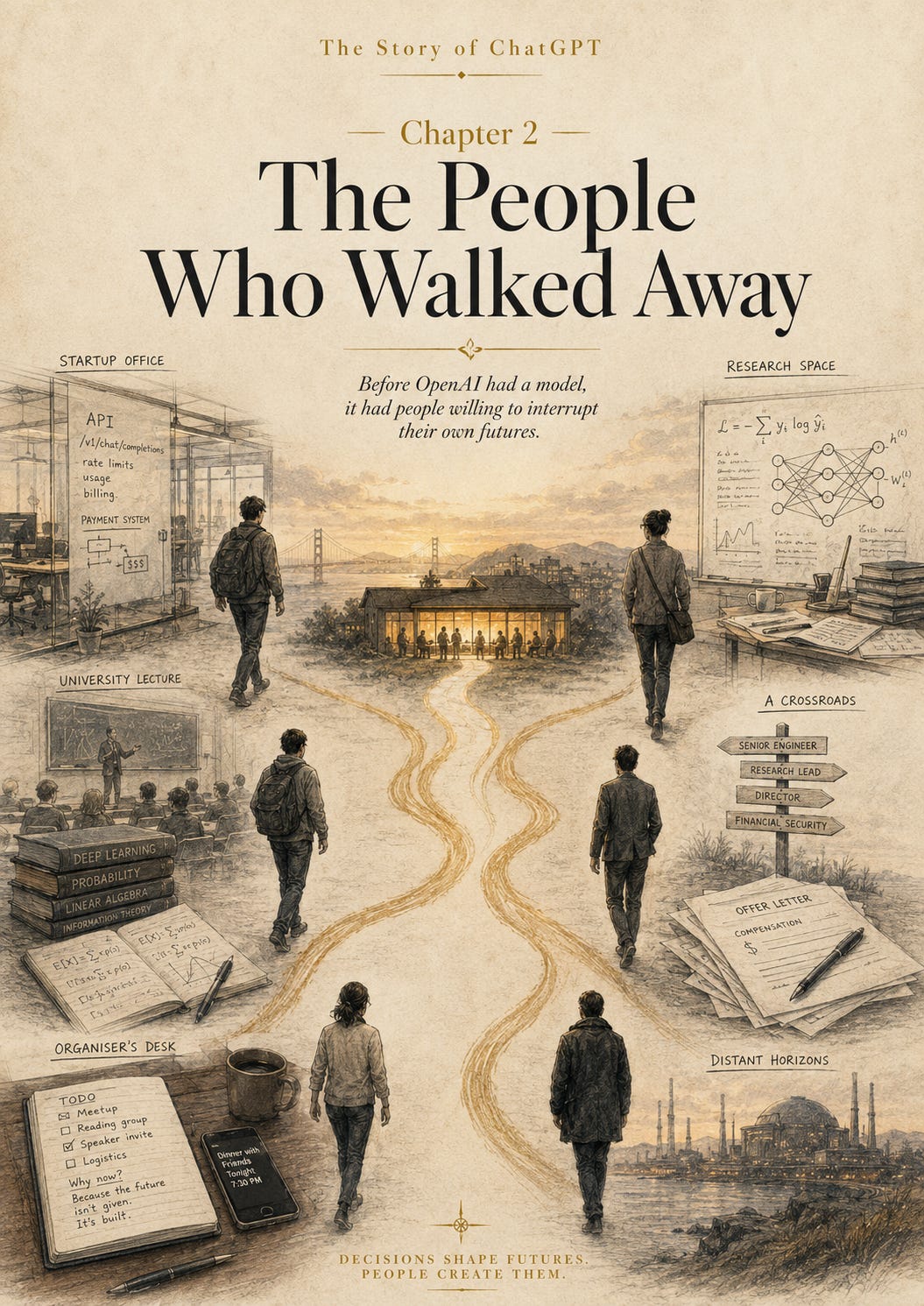
In May 2015, Greg Brockman left a company that was already working.
That is not usually how origin stories begin.
They often begin with failure. A dead end. A frustration. A person pushed out of one life and into another. But this was different. Greg was not walking away from collapse. He was walking away from momentum.
Stripe was becoming one of the cleanest pieces of infrastructure in Silicon Valley: a company built around the unglamorous but essential problem of making money move across the internet. Greg had joined early. He had helped build the systems beneath it. He had seen what happens when a small group of capable people turns a hard technical problem into a working machine.
And yet, in May 2015, he wrote that he was leaving.
There was no grand product announcement. No model demo. No chatbot waiting behind a curtain. Only a feeling that a rare opening had appeared, and that if he did not step through it, he would spend years wondering what might have happened. Greg described that period in his own writing as a “rare window”. Greg Brockman, “Leaving Stripe”
This is where it really begins: not with the founding list, but with a person standing at the edge of an existing life.
Because before OpenAI had a building, a product, a research agenda, or a public identity, it had to become believable to people who already had other futures available to them.
People at good companies.
People near the centre of artificial intelligence research.
People with money on the table.
People with academic momentum.
People with reputations that did not need this risk.
They did not all jump at once.
The idea had to gather them.
The goal said plainly
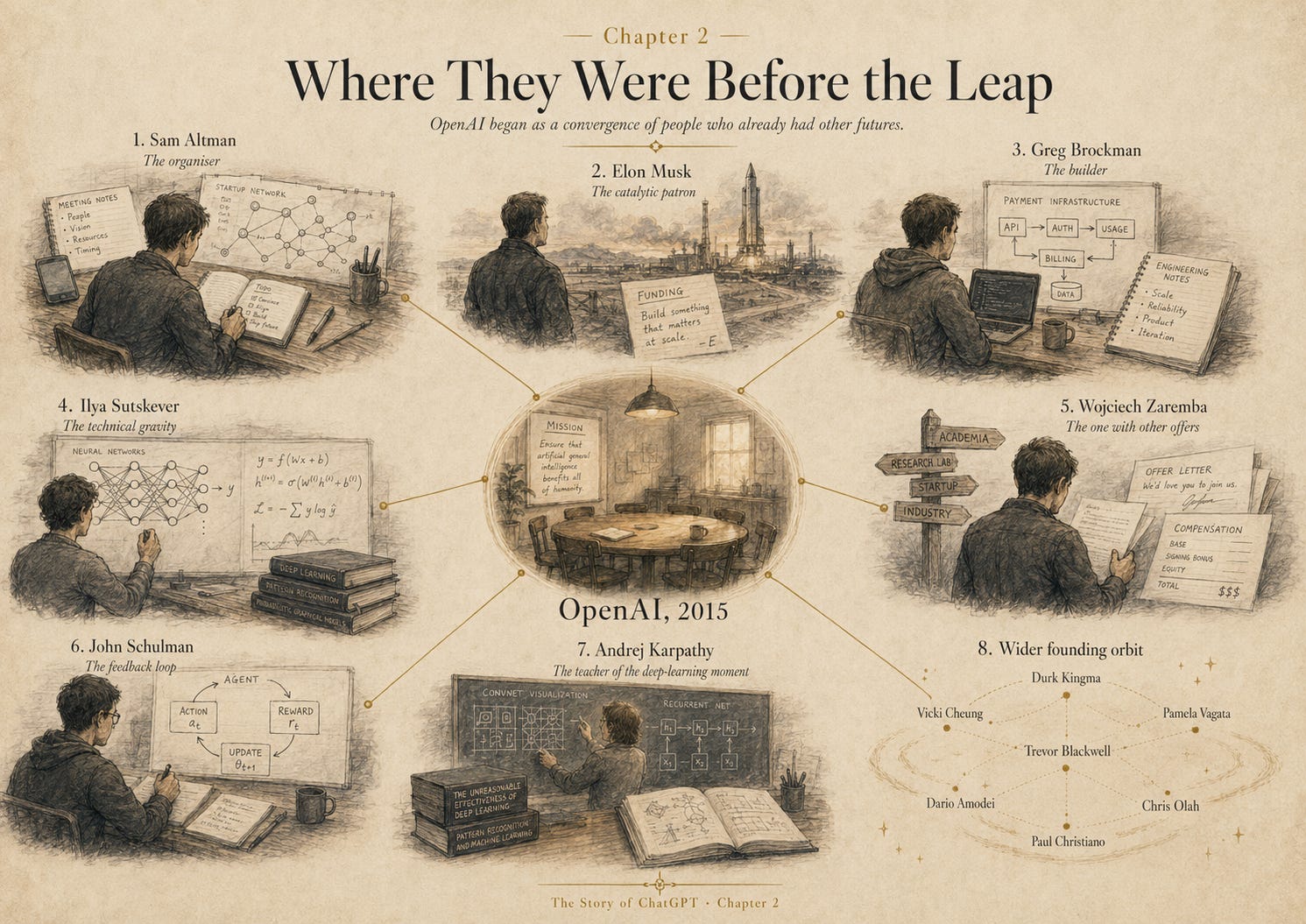
Sam Altman did not enter this part of the story as the scientist who would make the technical bet credible. He was not the engineer who would turn the lab into an organisation. His power was different.
He could make ambition social.
By 2015, Sam had already become president of Y Combinator, one of the central institutions in startup culture. TechCrunch reported in 2014 that he had taken over from Paul Graham as Y Combinator’s president, after being part of its first startup class in 2005 and later working as a partner. TechCrunch report on Sam Altman becoming Y Combinator president
That background matters, but not because this is a story about startups.
It matters because Sam understood something fragile about early ideas: they do not become real only because they are correct. They become real when enough serious people are willing to organise their lives around them.
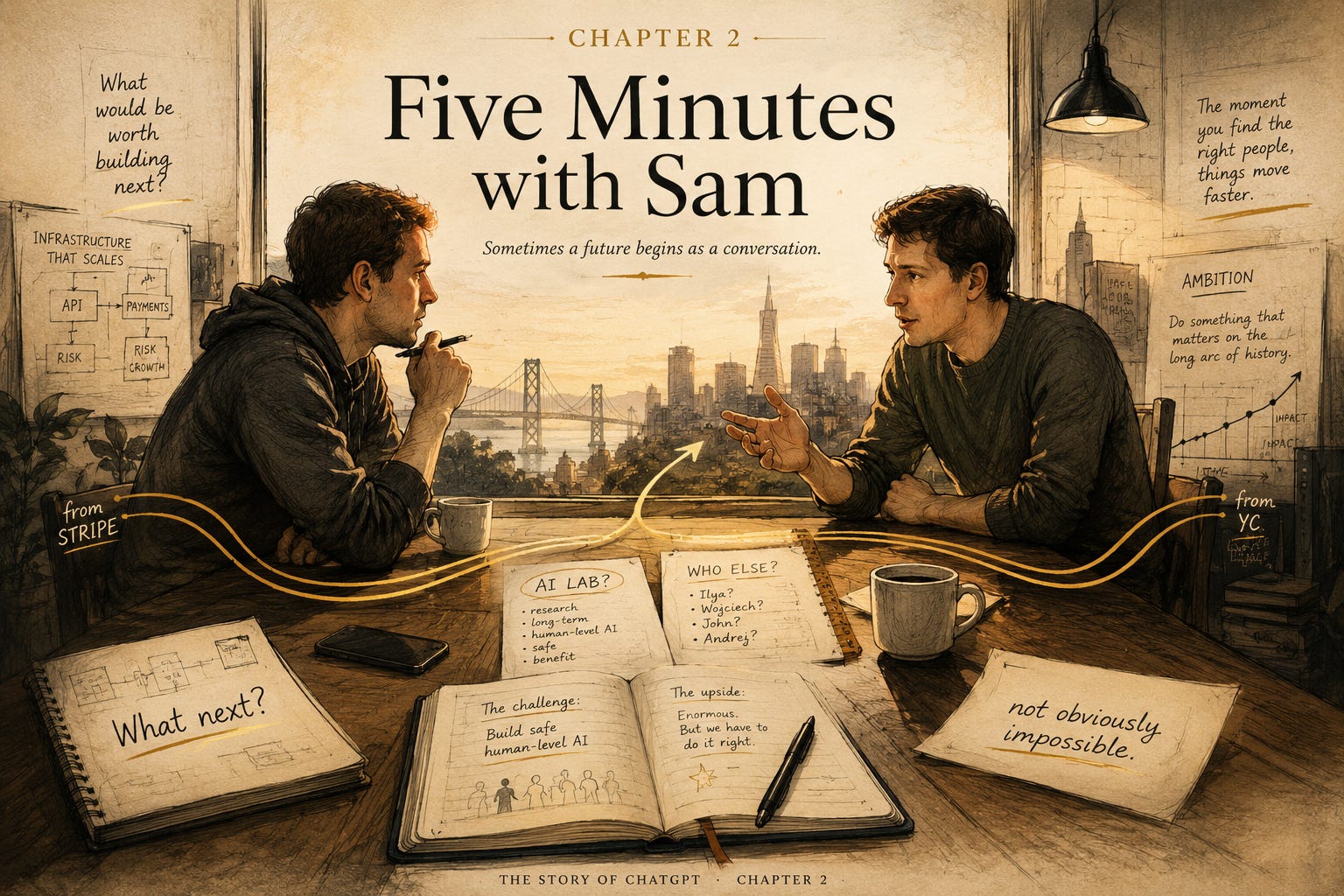
Greg’s path crossed Sam’s because Patrick Collison suggested the conversation. Greg was trying to decide what came next. Sam, according to Greg’s account, was also ready for something new. Very quickly, artificial intelligence came into the room. Sam mentioned that they had been thinking about creating an artificial intelligence lab through Y Combinator. Later, when Greg asked what such a lab would actually be for, Sam gave the answer that made the partnership click: safe human-level artificial intelligence. Greg Brockman, “My path to OpenAI”
It was an almost absurd phrase to say plainly.
Not better search. Not a clever app. Not a research group optimised for papers. Something much larger, and therefore much harder to say without sounding naive.
But that was Sam’s role in the early story. He could say the large thing without immediately shrinking it.
Some ideas need technical proof. Some need money. Some need a room.
This one first needed someone to make the ambition speakable.
A builder at the edge of a working machine
Greg heard the ambition differently because he had already built inside a working machine.
At Stripe, the work had been practical, concrete, infrastructural. Transactions had to move and systems had to scale. Engineers had to be recruited. Culture had to hold. This was not abstract ambition. It was the daily craft of making a technical organisation behave reliably under pressure.
That is why his departure matters. A person who has helped build something real brings a different question: what would it take to make this idea operational?
Greg was not merely asking whether artificial intelligence was important. He was asking whether a new kind of institution could be built around it.
Could they start from nothing? Could they attract the best researchers?
Could they design an organisation that did not immediately collapse into ordinary incentives?
He would later describe the question bluntly: would it be possible to create a lab from scratch with the best artificial intelligence researchers?
Their conclusion was not triumphant. It was not “obviously yes”.
It was smaller, stranger, and more useful: Not obviously impossible. Greg Brockman, “My path to OpenAI”
That phrase carries the early OpenAI mood better than almost anything else.
A narrow ledge between foolishness and possibility.
The stakes in the room
Elon Musk enters this chapter not as the whole story, but as a force that changed the temperature of the room.
By then, Elon was already associated with unusually large technical missions through Tesla and SpaceX. In the founding context of OpenAI, his presence brought money, urgency, public gravity, and a particular kind of fear: that artificial intelligence could become too powerful to leave entirely inside closed corporate systems.
The original OpenAI launch post named Sam Altman and Elon Musk as co-chairs. It also said that Sam, Greg, Elon, Reid Hoffman, Jessica Livingston, Peter Thiel, Amazon Web Services, Infosys, and YC Research were donating to support the organisation, with funders committing $1 billion, though OpenAI expected to spend only a small fraction of that in the first few years. OpenAI, “Introducing OpenAI”
Money alone did not make the lab real. But money changed the plausibility of the sentence.
A strange non-profit artificial intelligence lab sounded different when there were serious funders behind it. A warning about concentrated artificial intelligence sounded different when spoken by someone already associated with building rockets and electric cars.
Elon’s role in this part of the story is not that he made the idea technically credible. That would come from people like Ilya Sutskever.
His role was to make the stakes feel large enough that the risk could no longer be dismissed as eccentric.
One person could name the goal. Another could help make the danger feel real. Someone else still had to build the thing.
The dinner where the idea became social
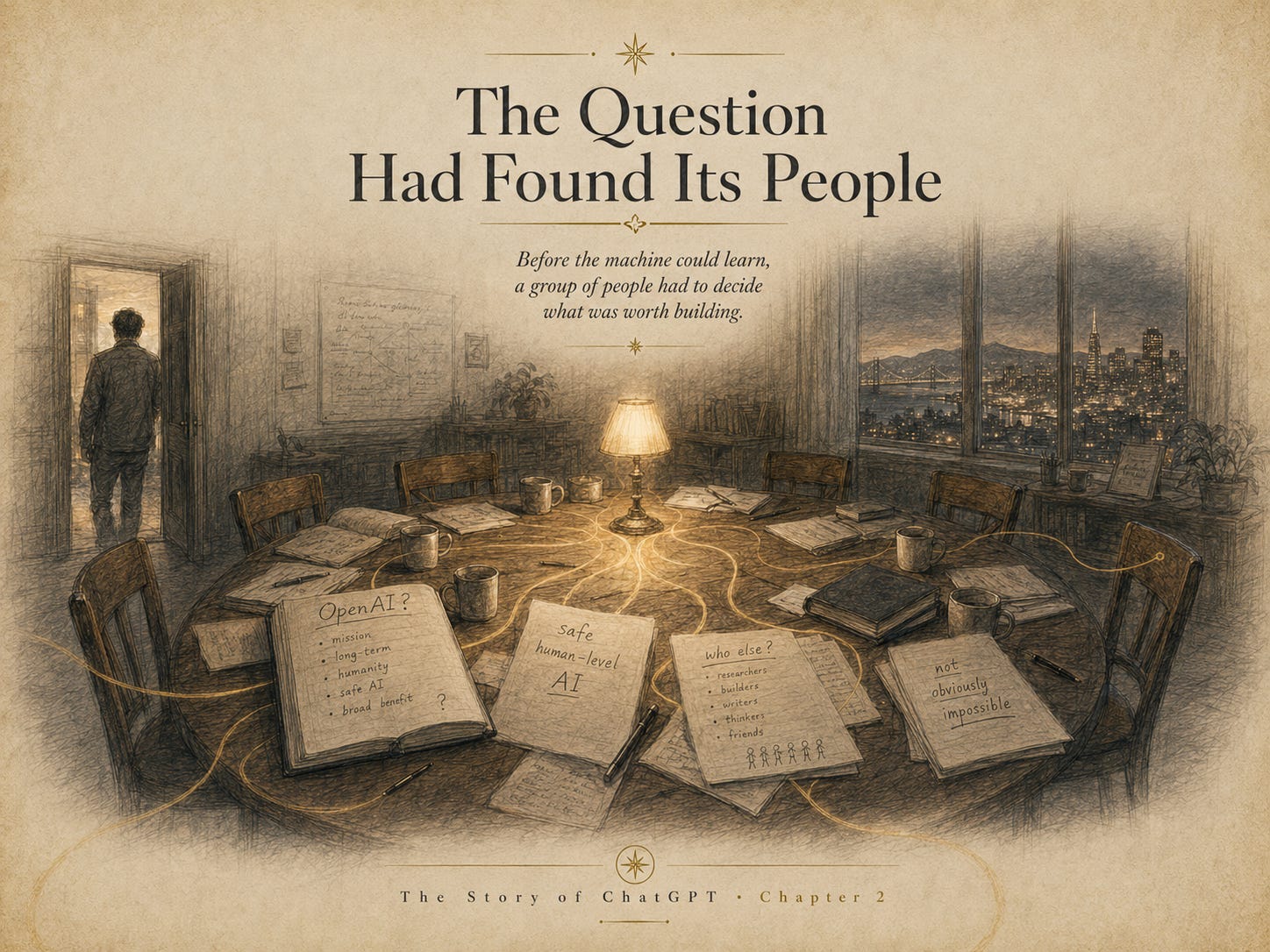
The idea had to leave the private conversation. It had to sit at a table with other people and survive being questioned.
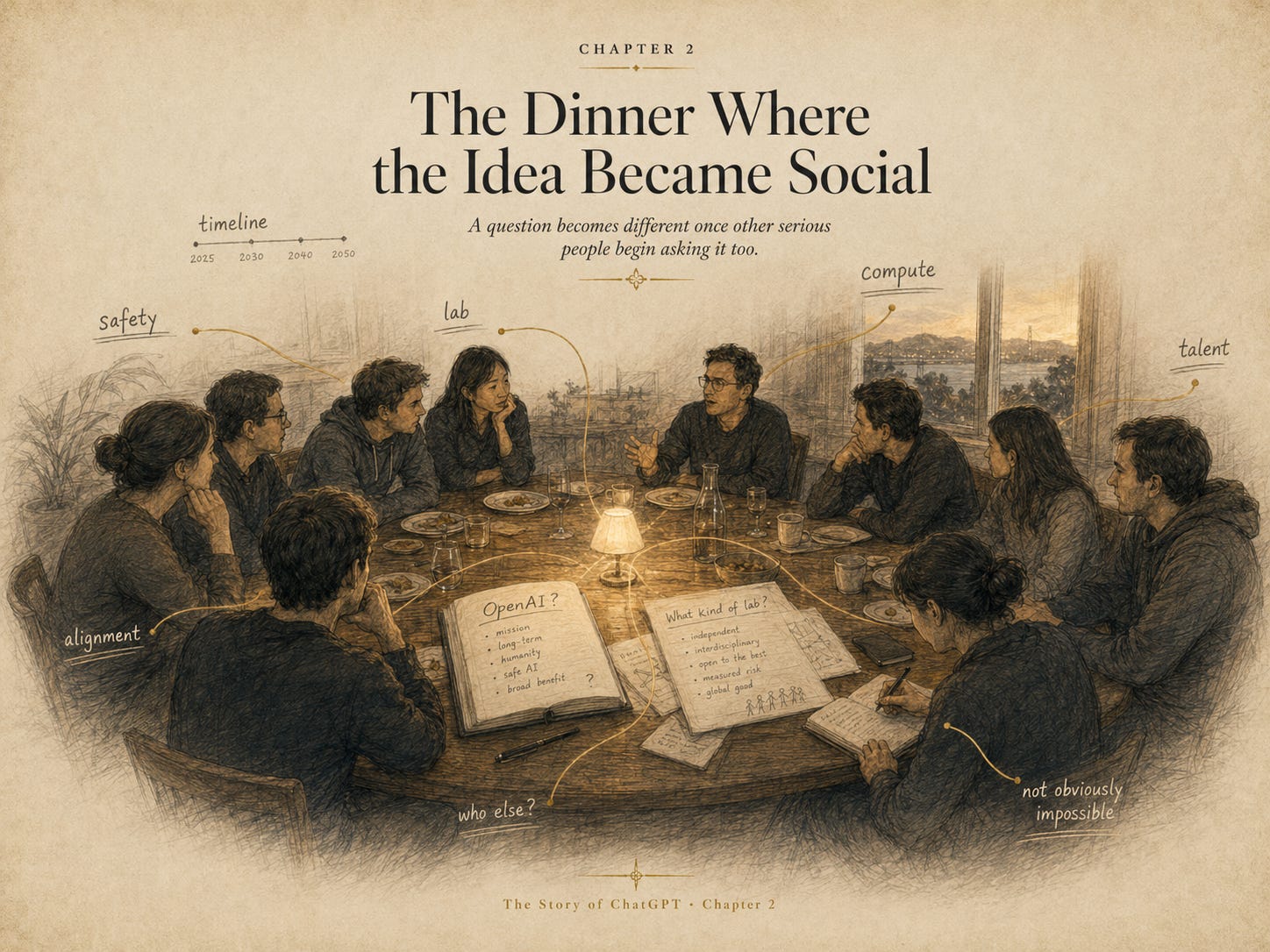
In Greg’s account, one of those tables was in Menlo Park. Around it were people who had been thinking, in different ways, about the same approaching problem: Sam Altman, Elon Musk, Greg Brockman, Ilya Sutskever, Dario Amodei, Chris Olah, Paul Christiano, and others. The conversation circled the state of the field, possible timelines to human-level artificial intelligence, and what kind of organisation could work on the problem without being swallowed by ordinary incentives. Greg Brockman, “My path to OpenAI”
It is easy, years later, to make that dinner feel inevitable. To imagine the future arriving cleanly, already named, already funded, already on its way to becoming a company people would recognise.
But the room would not have felt like that.
It would have felt more provisional. A table, some food, some notes, some people trying to decide whether the thing they were discussing was serious enough to rearrange their lives around.
A question being passed around.
What if the field really was moving faster than most people understood? What if the next step required more than another company lab? What if the people most capable of building powerful systems also had to think about the structure around those systems? What if the right organisation did not exist yet?
Somewhere in that conversation, the idea changed shape.
It stopped being only something Sam and Greg were exploring. It became something other serious people could test against their own judgement.
The question had entered the room. Now the room had to decide whether to become real.
The coordination problem
This is the part of founding stories that often gets cleaned up later.
Once an institution succeeds, the early uncertainty disappears from memory. The founding list looks fixed. The people look destined. The organisation feels as if it had always been waiting to exist.
But at the time, OpenAI was not yet OpenAI.
It was a question mark with some money, some ambition, and a handful of people trying to decide whether the question deserved their lives.
The early challenge was not simply recruiting talent.
It was recruiting belief.
Top people had options. They could work at Google. They could join DeepMind. They could stay in academia. They could take larger compensation packages. They could keep doing what already made sense.
So the question was not only:
Do you believe in this idea?
It was also:
Who else believes in it?
A world-class researcher does not want to be the only serious person in a room full of ambition. An ambitious organiser does not want to build a lab that cannot attract technical gravity. A builder does not want to leave a working company for a beautiful idea that never becomes an institution.
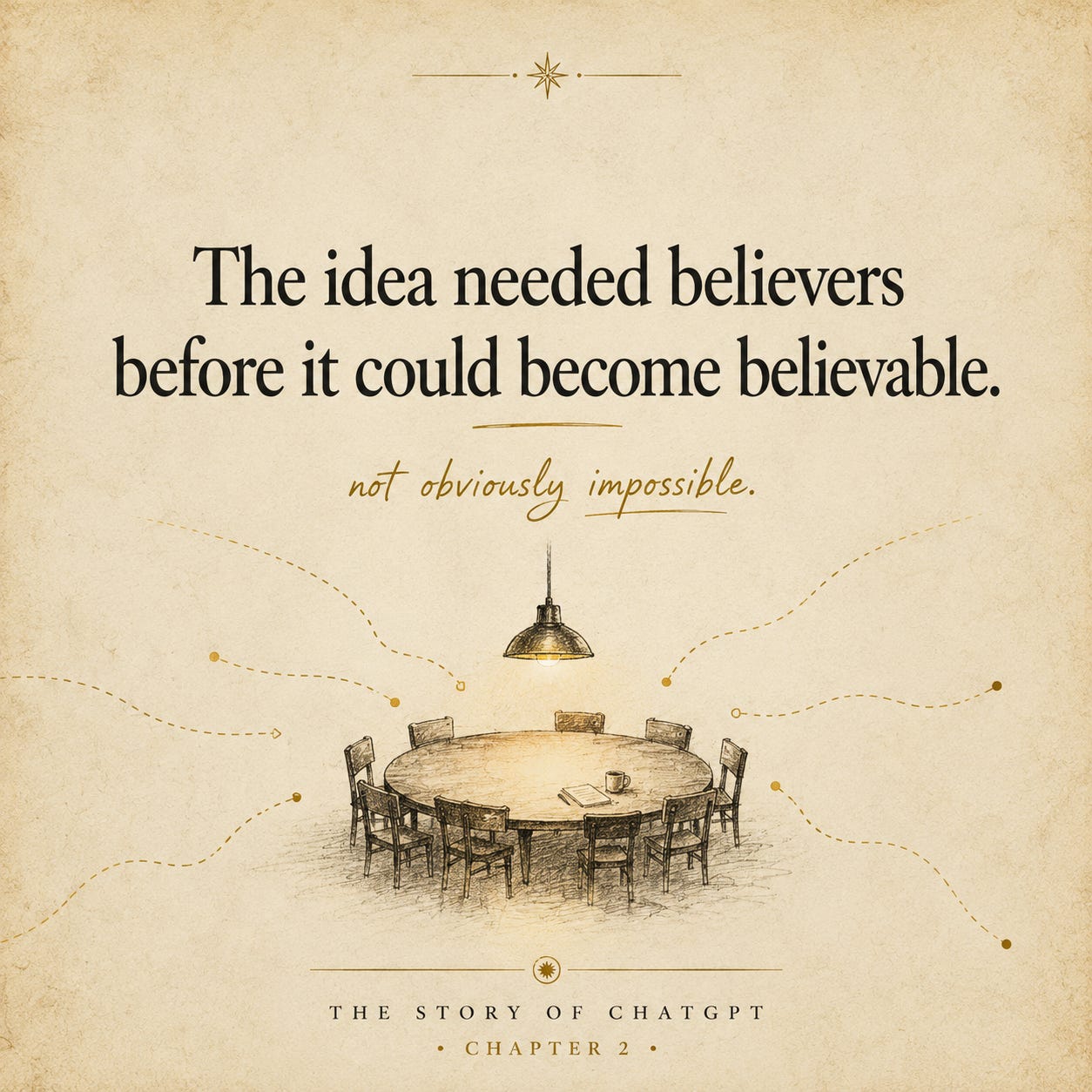
The idea needed believers before it could become believable.
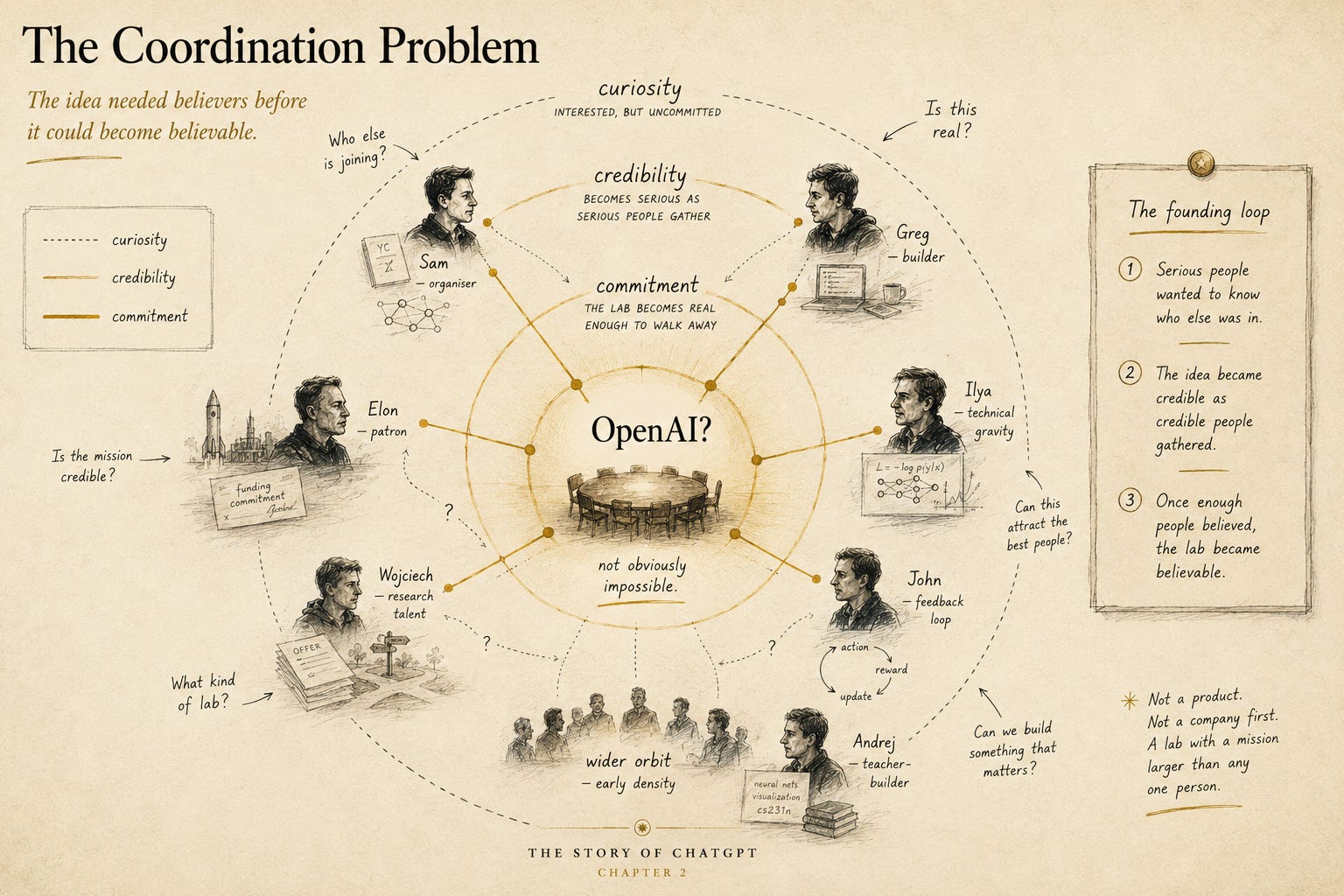
This was the founding loop.
Serious people wanted to know who else was in.
The idea became more credible as credible people gathered.
Once enough people believed, the lab became believable.
That is why “not obviously impossible” matters. It does not pretend the bet was safe. It does not remove the doubt. It simply marks the moment when doubt stopped being a reason to walk away.
Technical gravity
Ilya Sutskever changed the pitch simply by being near it.
He had been close to one of deep learning’s decisive public turns. In 2012, AlexNet, the neural network system built by Alex Krizhevsky, Ilya Sutskever, and Geoffrey Hinton, won the ImageNet Large Scale Visual Recognition Challenge by a striking margin and helped convince much of the field that deep learning was no longer a fringe bet.
By the time OpenAI was forming, Ilya had come through Hinton’s machine-learning group at the University of Toronto, co-founded DNNResearch, and spent three years as a research scientist at Google Brain. His own homepage describes that path, and also names him as co-founder and chief scientist of OpenAI. Ilya Sutskever homepage
That lineage matters.
Deep learning had moved from promise to proof. Systems trained on enough data were beginning to perform tasks that had once seemed to require carefully hand-coded intelligence. The old question, whether machines could learn useful representations from experience, was no longer merely philosophical. It was becoming empirical.
Ilya brought that gravity into the room.
Without someone like him, OpenAI could have sounded like a wealthy thought experiment. With him, it became a place where the frontier itself might move.
That was not decorative credibility.
It changed what the pitch meant.
Now the question was not only whether OpenAI should exist.
It was whether some of the strongest people in artificial intelligence might actually build there.
The people with other futures
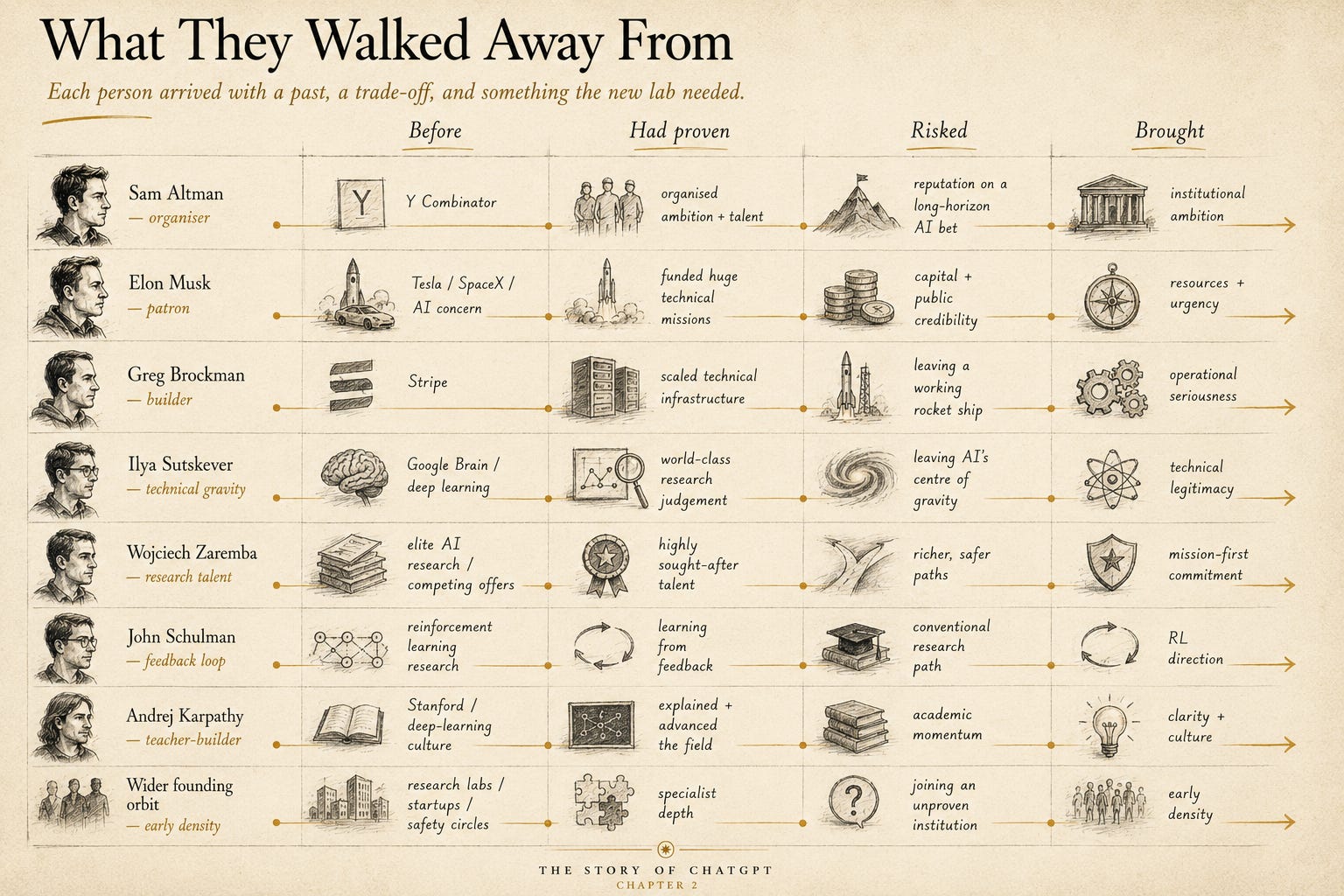
Wojciech Zaremba gave this story one of its clearest moments of trade-off. In 2016, WIRED reported that as OpenAI was coming together, he said he had been offered two or three times his market value. The detail matters because it gave the decision a visible cost. The market was saying one thing. The room was asking another.
Before OpenAI, John Schulman had worked on reinforcement learning at Berkeley — the branch of machine learning where an agent learns by acting, receiving a signal, and adjusting. One of the methods he helped develop, Trust Region Policy Optimisation, carried the kind of idea that would later matter enormously to OpenAI: improvement through feedback, not just prediction from data.
Berkeley later described him as co-founding OpenAI in December 2015 shortly before finishing his PhD in electrical engineering and computer sciences, and said he led the reinforcement-learning team that developed ChatGPT. UC Berkeley profile of John Schulman
Reinforcement learning is, at heart, about learning through action and feedback. A system tries something. It receives a signal. It adjusts. It tries again.
That idea will matter deeply in the road to ChatGPT, especially when the story reaches instruction following and reinforcement learning from human feedback. But here, John’s presence gives the founding group another kind of technical imagination.
A way of thinking about behaviour.
How does a system improve? What counts as a reward? How do you shape a machine’s actions without pretending you can specify everything in advance?
Before ChatGPT could feel conversational, before a model could be tuned to be useful rather than merely predictive, someone had to take feedback seriously.
Andrej Karpathy brought the culture of explanation.
At Stanford, his CS231n course turned deep learning into something students could see, diagram, code, and argue with. The course was not just a class. It was part of the public education of a field that was suddenly moving quickly.
His personal site describes him as an artificial intelligence researcher and educator, a founding member of OpenAI, later director of artificial intelligence at Tesla, and the architect and lead instructor of Stanford’s first deep-learning course, CS231n. Andrej Karpathy personal site
This matters because deep learning was not only a research frontier by 2015. It was becoming a culture.
People were reading papers, sharing code, watching lectures, experimenting with neural networks, building intuition through diagrams and notebooks and demos. The field was not yet ordinary. It still had the feeling of a door opening.
Karpathy represented that atmosphere: rigorous, technical, but unusually legible. Someone who could both work near the frontier and help others see why the frontier mattered.
Every early lab needs more than specialists.
It needs people who can make a sealed door feel like an open one.
The official OpenAI launch post would later list the founding group with confidence: Greg Brockman as chief technology officer, Ilya Sutskever as research director, and Trevor Blackwell, Vicki Cheung, Andrej Karpathy, Durk Kingma, John Schulman, Pamela Vagata, and Wojciech Zaremba among the founding research engineers and scientists. Sam Altman and Elon Musk were named as co-chairs. OpenAI, “Introducing OpenAI”
In a list, names become flat.
On the page, they sit neatly beside each other, as if everyone had always belonged to the same sentence.
By December 2015, OpenAI could finally describe itself in public: a non-profit artificial intelligence research company, created to advance digital intelligence in the way most likely to benefit humanity as a whole. OpenAI, “Introducing OpenAI”
But the public language was not the beginning.
There was no ChatGPT. No global argument about what intelligence had become.
There were only people around a table, trying to decide whether a new kind of lab could exist.
The beginning was quieter.
A person leaving a company that was working.
A conversation about what might be worth building next.
A goal said almost too plainly.
A dinner where the idea became social.
A room full of people asking who else was serious.
A set of careers bending, not yet towards a product, but towards a question.
What they shared was not a single background.
It was a willingness to move while the future was still uncertain.
And for a brief moment, that was enough.
Not obviously impossible. That was enough.