

Part I: The Spark
Chapter 1: The Room Where the Bet Was Made
Before ChatGPT became a product, it began as a question: who should shape the future of intelligence?

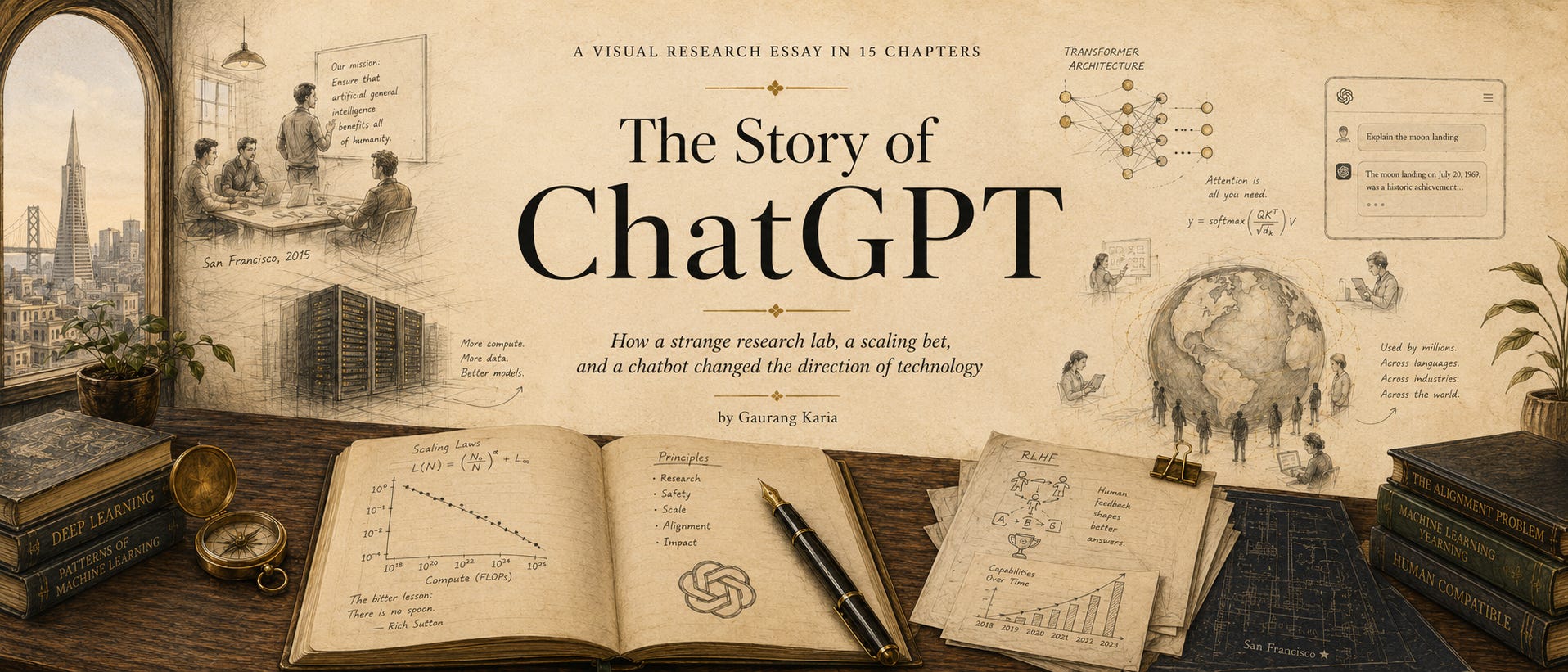
The Story of ChatGPT is a visual research essay I’ll be publishing chapter by chapter.
It traces how a strange research lab, a scaling bet, and a chatbot changed the direction of technology — through people, ideas, compute, institutions, and questions that still haven’t settled.
Chapter 1 begins before ChatGPT became a product.

The Room Where the Bet Was Made
A room, a whiteboard, a few people leaning towards a question the rest of the world had not yet noticed.
The coffee has probably gone cold.
That is the kind of detail history never records, but rooms remember. A cup left too long beside a laptop. A marker without its cap. A whiteboard half-filled with arrows, names, fragments of thought that made sense only while someone was standing in front of them, talking with their hands.
There is no public photograph of the room that matters here. No grand portrait of everyone turning towards the camera at the precise moment the future becomes visible. Technology rarely begins like that. It begins in ordinary rooms, among people who are still trying to decide whether the thing they are sensing is real.
In 2015, artificial intelligence had not yet become a daily habit.
It did not sit in a text box waiting for instructions. It did not help a child with homework, a founder with a pitch deck, an engineer with a broken function, or a tired manager with the email they no longer had the patience to write. It had not yet entered kitchens, classrooms, offices, WhatsApp groups, and family conversations. It had not yet become the invisible colleague people argued with, trusted too quickly, doubted too late, and returned to anyway.
For most of the world, artificial intelligence still lived somewhere else: in films, research labs, chess stories, recommendation systems, and the strange feeling that your phone had started to know you slightly too well.
But inside a smaller world of researchers, founders, and technologists, the air had changed.

The Coffee Has Probably Gone Cold
The ordinary objects of a beginning: coffee, paper, a laptop, and a question not yet fully formed.
Machines were learning things that used to require carefully written rules. They were recognising images, transcribing speech, translating languages, and improving when given more data, more computation, and better methods. The machine was not thinking like a person. But it was no longer only obeying like a calculator.
That difference is easy to understate now because we live after the shock.
A traditional program carries the shape of the instructions someone gives it. A person writes the rules; the machine follows them. Machine learning changed the bargain. Engineers could now train systems on examples. Enough images, enough speech, enough text, enough feedback, enough compute, and the system could begin to find patterns that no one had explicitly written down.
This was the quiet crack in the wall.
Not intelligence yet. Not consciousness. Not the science-fiction machine with its tidy apocalypse.
Something more modest, and in some ways more unsettling: capability that improved with scale.
Once you see that, the question changes.
The first question is technical: can this be built?
The second is institutional: who gets to build it?
The Founding Bet
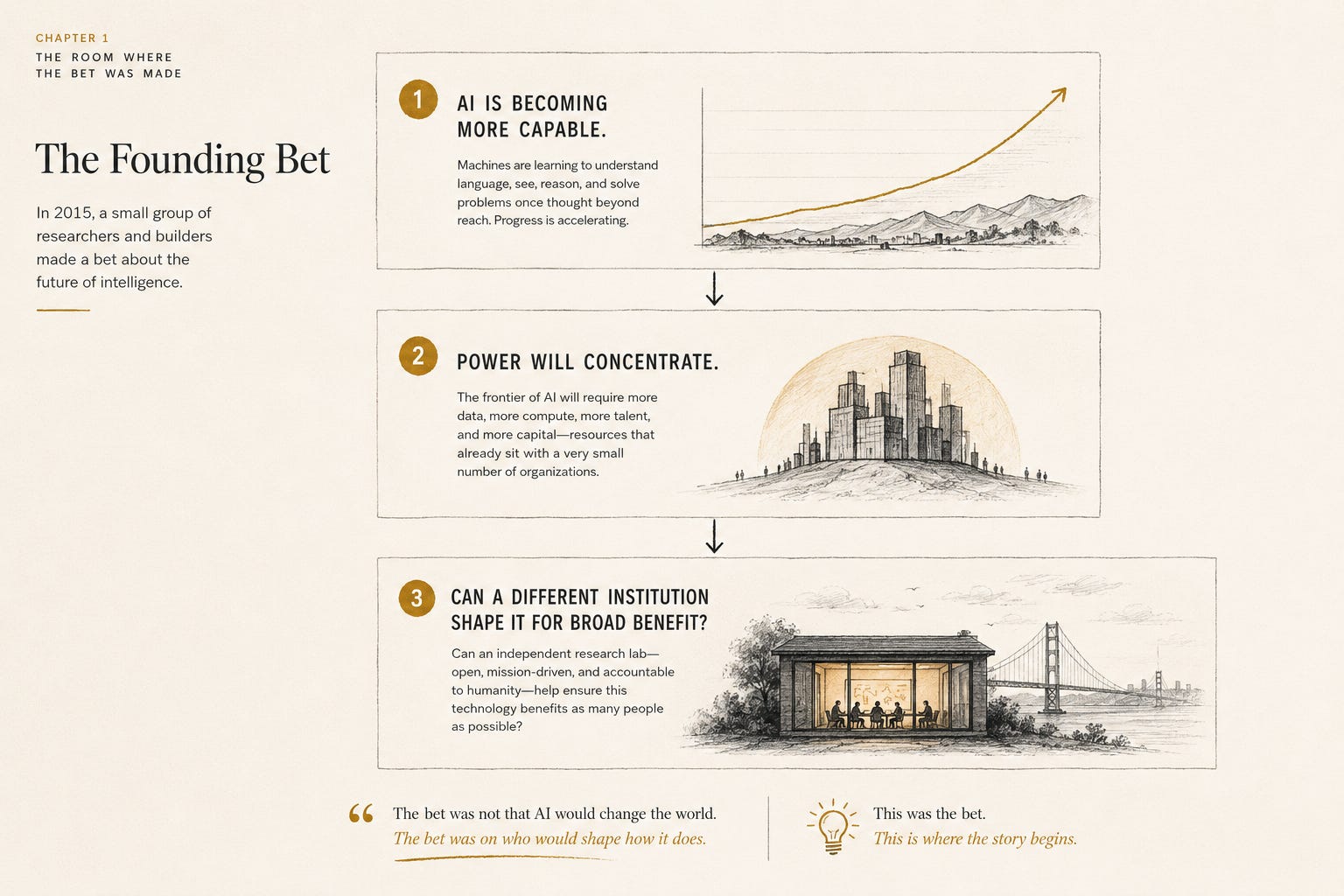
The founding bet was not only that artificial intelligence would become powerful. It was that the structure around power would matter.
By late 2015, the answer to who could build advanced artificial intelligence seemed to be narrowing.
The organisations best placed to work at the frontier were the ones with money, data, infrastructure, talent, and patience for expensive experiments. In other words: the largest technology companies.
The same pattern had already shaped the internet age. Search concentrated. Social networking concentrated. Smartphones concentrated.
Artificial intelligence looked like it might become the next interface.
Maybe the deepest one.
Not another app on the screen, but the layer beneath the apps. The thing that answered, suggested, wrote, saw, listened, summarised, planned, translated, coded, negotiated, and eventually acted. If that layer belonged entirely to a handful of companies, then the future would not simply be automated. It would be mediated.
That was the unease. Not panic. Not certainty. More like a recognition.
The kind that arrives quietly, then refuses to leave.
When OpenAI introduced itself on 11 December 2015, it did not announce a chatbot. It did not announce a consumer product. It described itself as a non-profit artificial intelligence research company, with the goal of advancing digital intelligence in the way most likely to benefit humanity as a whole, unconstrained by the need to generate financial return. Introducing OpenAI
That sentence is the first doorway into the whole story. Benefit humanity as a whole.
It sounds clean until you hold it for more than a moment.
Humanity is not one customer. It is not one market segment, one country, one language, or one neat set of requirements.
It includes the artist wondering whether the internet has become a training set with a payment system missing. The teacher trying to understand whether a student has learned. The engineer shipping faster than before. The person who will never know that a system has quietly shaped the options placed in front of them.
To say humanity is the beneficiary is to make a promise that cannot be checked with a dashboard.
It turns every later decision into a question.
Who gets access? Who gets protected? Who pays? Who profits? Who decides when a system is safe enough to release?
At the beginning, those questions had not yet hardened into the public arguments they would later become. They were still weather in the distance. The founding energy was brighter than that: ambitious, idealistic, impatient with the default path. It carried the feeling of people looking at the same map and realising the road everyone expected them to take might lead somewhere dangerous.
This is why the room matters.
Not because every answer was found there. Not because the people in it were free from ambition, ego, money, rivalry, or contradiction. A clean myth would be easier: a small group of noble outsiders standing against the machine. But OpenAI did not begin outside the centre of power. It began close to it.
Close enough to know what it might cost to lose.
There were researchers leaving prestigious labs, founders bringing speed and ambition, backers bringing capital, and engineers choosing a road that did not yet have a stable name. The idealism was real, but it did not arrive untouched by ambition. The caution was real, but it had to sit beside the desire to build.
That is what makes the story worth telling.
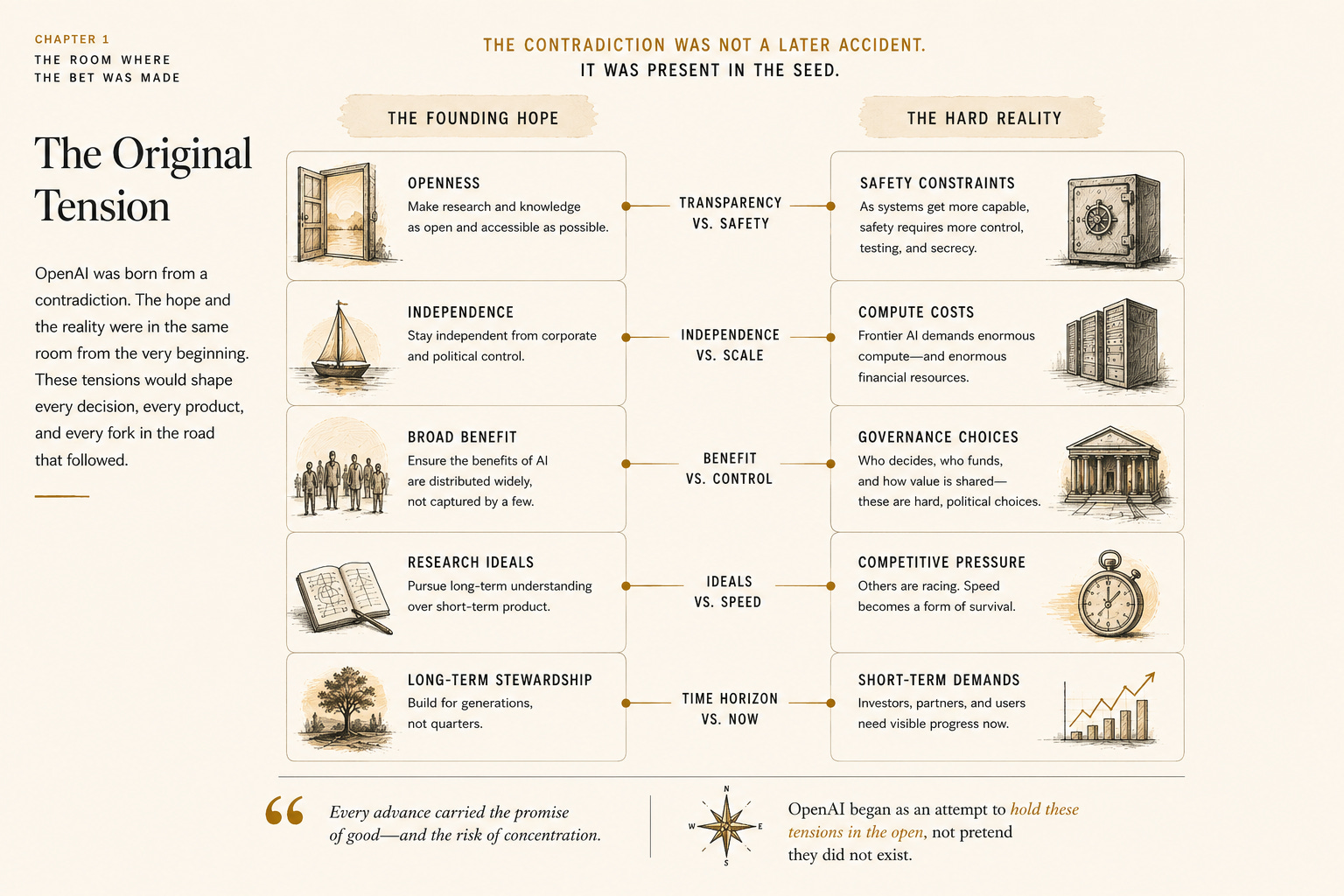
The Original Tension
The contradiction was not a later accident. It was present in the seed.
The original idea was not to stop artificial intelligence from being built. It was to ask whether a different kind of institution could exist at the frontier: a research lab with enough technical ambition to matter, enough independence to resist capture, enough openness to share what it learned, and enough responsibility to avoid turning power into spectacle.
Even as an idea, it was difficult to hold.
OpenAI wanted openness, but advanced systems might not always be safe to release openly. It wanted broad benefit, but broad benefit is hard to define before the harm arrives. It wanted independence from ordinary financial pressure, but frontier artificial intelligence would eventually demand extraordinary amounts of compute. It wanted to serve humanity, but humanity does not sit neatly around a board table.
The contradictions were not a later corruption of the story. They were present in the seed. That does not make the seed false. It makes it alive.
Every serious mission contains a tension it has not yet learned how to survive. A writer says they want to tell the truth, then discovers truth has consequences. A parent says they want to protect their child, then discovers protection can become control. An engineer says they want to build a better system, then discovers that better for whom is the real specification.
OpenAI’s founding promise had that shape.
It was not simply: we will build artificial intelligence.
It was: if something like artificial general intelligence becomes possible, it should be guided towards the benefit of everyone.
Artificial general intelligence, or AGI, was the larger horizon. Not a tool trained for one narrow task, but a system capable across a wide range of intellectual work. OpenAI’s later Charter would state the mission directly: to ensure that AGI benefits all of humanity, while acknowledging uncertainty around timelines and committing the organisation to act in humanity’s best interests throughout development. OpenAI Charter
In 2015, that horizon was still hazy. Close enough for serious people to organise around it. Far enough for almost everyone else to carry on as usual.
Outside the room, life moved at its normal pace. People opened laptops, checked messages, searched the web, streamed music, ordered cars, uploaded photos, and let algorithms quietly rearrange the edges of their attention.
The internet had already become ordinary, which is the most powerful thing a technology can become. Once something is ordinary, it no longer feels like an invention. It feels like weather.
Artificial intelligence was moving towards that same fate.
First hidden inside other things. Better search. Better recommendations. Better translations. Better speech recognition. Better image tagging. Then slowly more visible. Then suddenly conversational. Then everywhere.
But that was later. For now, there was only the beginning of the question.
A room. A bet. A promise large enough to become a burden.
The bet was not that artificial intelligence would be useful. Many people already believed that. The bet was not even that it would become powerful. The deeper bet was that the structure around intelligence would matter as much as the intelligence itself.
Who funds it. Who steers it. Who restrains it. Who benefits from it. Who can challenge it. Who gets locked out.
These were not product questions.
They were civilisation questions wearing technical clothes.
And maybe that is why the early language feels almost too sincere now. “Benefit humanity as a whole” can sound naive when read from the future, after the partnerships, the competition, the commercial pressure, the governance fights, the acceleration, the money. But sometimes the promise matters precisely because the world will later make it hard to keep.
A mission statement is not proof that the future will obey.
It is a mark on the wall showing where the builders first claimed to be going.
Years later, people would argue over whether OpenAI had stayed true to that mark, drifted from it, adapted it, betrayed it, or discovered that the original shape could not survive what it was about to become.
Those arguments matter. They belong to later chapters. But before the judgement, there has to be the beginning.

The beginning was not a product launch. It was a recognition.
Not certainty. Not purity. Not a finished philosophy. A difficult question, asked early enough to matter.
The room did not answer the question. It gave the question a place to stand.