

The Weekly Commit #010: "Everything, Everywhere, All at Once"
Season One finale. Nine commits. One question, asked nine different ways.

Listen
Prefer audio? Listen on your platform of choice and keep the show notes here.

The cappuccino is still warm.
Outside, London moves at its particular pace. Indifferent. Magnificent. Somewhere beyond the rooftops, the Thames is doing what it has always done: flowing without asking, arriving without announcing.
I have my laptop open. Nine tabs.
Nine weeks. Nine pieces of writing that started as a newsletter and became something I still don’t have a clean word for.
I’ve been sitting here trying to write the tenth.
The cursor blinks. I scroll back through the nine. Ratna and his hooks. A London cinema on Republic Day, watching Border 2 with a lump in my throat. Sir Alex in a dark room, making the only call the role permitted. The COVID years, the dashboards, the weight of staying permanently ready. A request that arrived just as I was leaving. Mac minis and the idea that the world bends. My daughter with her tie already missing. My mum at the edge of the escalator. A terminal scrolling with code I didn’t write.
And something happens.
Not an idea. More like a recognition.
The kind that arrives quietly — like suddenly seeing a face in a painting I’ve walked past a hundred times.
✳ What I Didn’t Know I Was Writing
There is a film called Everything, Everywhere, All at Once. It is about a woman named Evelyn who discovers she can access every version of herself across every possible universe — every choice made, every path not taken, every life she could have lived. All at once.
It sounds like spectacle. It is, underneath, the simplest story ever told: you are more than you think you are. And the only way to find out is to be broken open.
I kept thinking about Evelyn as I prepared this piece. Not because my life resembles hers. But because of what happens to her when all those universes arrive simultaneously — she doesn’t gain clarity from the chaos. She gains recognition. The sense that something she already knew, deep down, has finally been confirmed from every direction at once.
That is what happened when I started reading.
I want to be honest about something.
When I started The Weekly Commit, I wasn’t thinking about philosophy. I wasn’t thinking about ancient traditions or universal frameworks. I was just showing up. Writing from whatever the week gave me — a football match, a documentary, a moment at a train station, a conversation at the dinner table.
I wrote from instinct. From lived experience. From the need to make sense of things in the only way I know how: by putting them into words.
And then, preparing for this tenth piece, something unexpected happened.
I started reading.
And I discovered that the things I had been circling — without a map, without a plan, without even knowing there was a territory — had been described before. Precisely. Carefully. By people who lived thousands of years ago and thousands of miles away.
That stopped me cold.
Not because I had been clever. Because I hadn’t been. I had simply been honest. And honesty, it turns out, leads everyone to the same place eventually.
🧭 The Story That Never Changes
There is a scholar named Joseph Campbell who spent his life reading the myths of every culture on earth, looking for the differences.
He found the same story.
Every culture, every era, every tradition: a person leaves the familiar world, faces a trial that breaks something in them open, and returns — different, carrying something the world needs.
Campbell called it the Hero’s Journey. Not because heroes are special. Because the journey is universal.
I read this and sat very still for a moment.
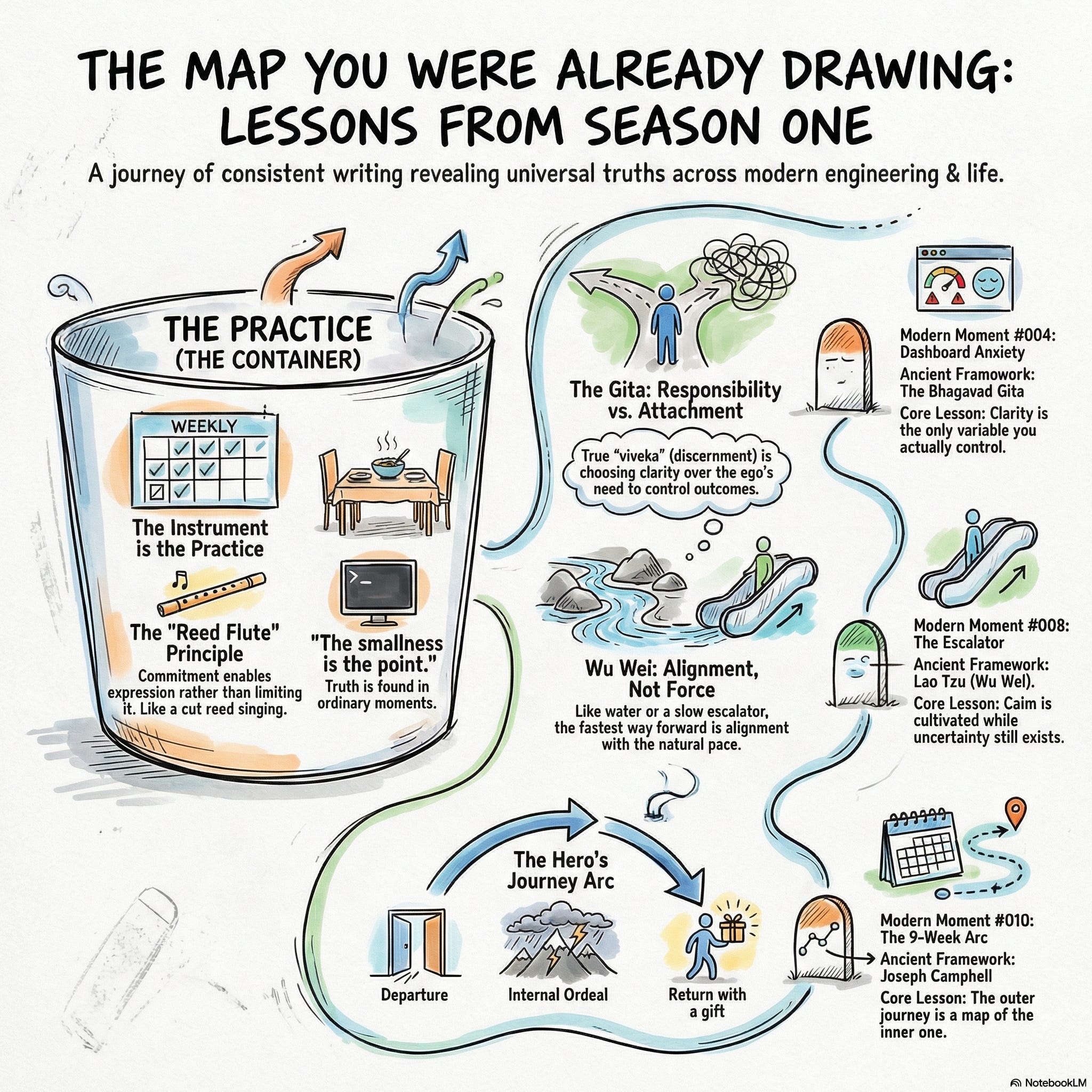
Because the nine commits are that arc.
#001 is the departure — not dramatic, just a decision to show up after a long absence. An init commit. A small, unremarkable yes. Every journey begins with one.
#002 and #003 cross the threshold into the world of real stakes. Code in production. Ferguson at Old Trafford. Things that cannot be taken back.
#004 and #005 are the ordeal. Not a villain. A mirror. The anxiety beneath the vigilance. The leverage dressed as urgency. The trial that breaks something open is always internal — it is never really about the dashboard or the request or the production outage. It is about who I am when the system pushes back.
#006 is the revelation. The world is editable. The moment I stopped reacting and started choosing.
#007 and #008 are the return — the gift carried home. Not technology. Not a framework. Just the quality of attention: to a child with her pencil, to a mother with her hand gripped tight on her handbag.
#009 is the elixir. Quiet. Undramatic. Read the one function. Stay in the conversation.
I didn’t plan this shape. I wrote nine things and the shape was already there, waiting to be seen.
Campbell said the reason this story appears in every culture is that it isn’t really a story about events. It is a story about transformation. The outer journey is a map of the inner one.
Nine weeks. One map. I just didn’t know I was drawing it.
⚙️ Arjuna Put Down His Bow
The Bhagavad Gita I knew.
It is the one tradition in this piece that I came to before the writing — not through study, but through culture, through growing up, through the slow absorption of ideas that travel in families and festivals and the particular texture of an Indian childhood.
So when I read #004 back — the piece about proactiveness turning into anxiety — and felt the Gita in it, I was not surprised. I was just finally seeing what had always been underneath.
The Gita opens with a general named Arjuna standing between two armies, looking at the faces of the people he is about to fight.
He puts down his bow.
I cannot do this.
Not because he lacks courage. Because he cannot reconcile what he knows with what he feels. The soldier in him knows what the moment requires. The human in him cannot move.
That is #004.
The constant vigilance, the scanning, the bracing against failure before it arrives — none of it was irresponsibility. It was caring, dressed in armour it didn’t need. The Gita has a name for this: ahamkara — the ego’s need to be the one who holds everything together. The belief that if you stop watching, something will break that only you could have prevented.
Krishna’s answer is not stop caring. It is: your clarity when things break is the only variable you actually control. Everything else is attachment pretending to be responsibility.
#005 is the Gita’s next chapter. The stress test — the request that arrives just as I’m leaving — is what happens when someone mistakes compliance for loyalty. The Gita calls discernment viveka: the ability to see clearly what is actually happening, without the distortion of guilt or the need to be seen as a team player.
And then there is Ferguson’s dark room in #003.
He dropped his goalkeeper. A loyal soldier from the Aberdeen years. A friend. He chose the project over the friendship and sat alone with the weight of it.
The Gita calls this nishkama karma — action without personal attachment to the outcome. Not cold. The documentary shows a man in pain. But the action was clean. The role required what the role required, regardless of what it cost him personally.
I did not need to discover the Gita. It had already found me.
🎋 The Escalator and the River
I came to Lao Tzu sideways. Not looking for it.
A 2,500-year-old Chinese text. Short. Deceptively simple. Almost impossible to fully translate because the concepts don’t map cleanly onto English. Wu wei — often translated as effortless action, or non-forcing — is perhaps the closest thing to a description of what happened at the escalator in #008.
The escalator moved at its own pace. London moved at its own pace. And all the urgency — come on, we’ll miss the train — was force applied against the natural pace of another person.
The moment I stopped, took her hand, counted to three — that was not weakness. That was alignment. The train, it turned out, was not missed.
Lao Tzu writes about water constantly. Water is his favourite image for wu wei. Water doesn’t force. It doesn’t argue with the rock. It finds the lowest path, takes the shape of whatever contains it, and arrives — always, eventually — at the sea.
Calm is something you cultivate while uncertainty still exists.
That line from #004 is water. I wrote it without knowing Lao Tzu had already said the same thing, differently, two and a half millennia ago.
The Thames outside does not care whether I have read Lao Tzu. It just keeps moving — the way it always has, without asking, without announcing, without needing an audience.
🌀 The Instrument Being Made
Before #001, I wrote.
Just not like this.
Articles went up when an idea arrived. Topics were whatever caught my attention that week — a film, a concept, a thought that seemed worth sharing. There was no cadence, no container, no commitment. Just wandering, occasionally publishing, and wondering why nothing seemed to accumulate into anything.
The Weekly Commit changed one thing: it gave me a structure I didn’t have to think about. Show up. Be open. Write from whatever the week gives me — even if it is small, even if it is unresolved, even if it doesn’t feel like enough.
And something unexpected happened inside that constraint.
The smallness became the point. An escalator. A dinner table. A terminal screen at night. Ordinary moments that I would previously have dismissed as not quite enough for a proper article — turned out to be exactly the right material. Not because they were dramatic. Because they were true.
There is an old idea, found in different forms across different traditions, that a container doesn’t limit expression — it enables it. The reed makes no sound until it is cut into a specific shape. The river has no force until the banks give it direction. The poem has no weight until the line breaks at the right place.
Rumi built an entire philosophy around this. The 13th century Persian poet and Sufi mystic opened his greatest work — the Masnavi — with the image of a reed flute crying because it has been cut from the reed bed. Separated from its origin. Longing. And that longing, he said, is not the absence of music. It is the music. The reed makes no sound while still rooted. The cutting is the condition for the singing.
The Weekly Commit was the container.
The wandering before it was not wasted. It was how I learned what I actually had to say. But the saying required a shape — a weekly cadence, a commitment to showing up regardless, permission to write from the small rather than wait for the large.
Nine commits. Nine small moments that turned out to be the same large question.
That doesn’t happen without the container.
The instrument isn’t the writer.
The instrument is the practice.
✳ What the Patterns Are Telling Me
Here is what stops me, sitting in this café with nine tabs open.
I wrote these pieces from instinct. From whatever the week gave me — a documentary, a commute, a dinner table, a terminal screen. I was not trying to trace a hero’s journey. I was not trying to illustrate the Gita. I had not read Lao Tzu.
And yet.
Every tradition I’ve encountered in the preparation for this piece — traditions separated by centuries and continents and languages — had already been to the place the nine commits describe. They had mapped the same territory. Left the same notes.
Different names. Different images. Different centuries.
Same wall.
And the nine commits — written weekly, without a plan, from the material of an ordinary life — had been hitting that wall from nine different angles.
I don’t think this is coincidence.
I think this is what happens when you write honestly enough, for long enough. I stop describing my own experience and start describing something older. Something shared. Something that was waiting to be named again, in this particular language, at this particular moment.
The universe, it turns out, has been taking notes.
🔁 Back at the Café
The cappuccino is cold now.
Outside, London keeps moving. The river keeps moving. The cursor blinks on the open document — this one, the tenth — waiting for the word that closes the season and opens the next question.
I look at the nine tabs.
Ratna, who engineered a new protocol because the old one no longer applied to his body. Ferguson, in the dark room, making the only call the role permitted. My daughter, serious-faced at the table, proud in a way that couldn’t be outsourced. My mum — one word, wait — teaching me more about pace than any retrospective I’ve attended.
Nine ordinary moments.
Nine notes from the same instrument.
And underneath all of them — underneath Campbell’s arc and the Gita’s teaching and the river’s patient movement and the break that became the beginning — one question, asked nine different ways, in nine different weeks, by me, just trying to show up consistently:
Who are you when the system does the work for you?
I don’t have a final answer.
But I have nine honest attempts at it.
And something tells me that was always the point.
📌 Commit
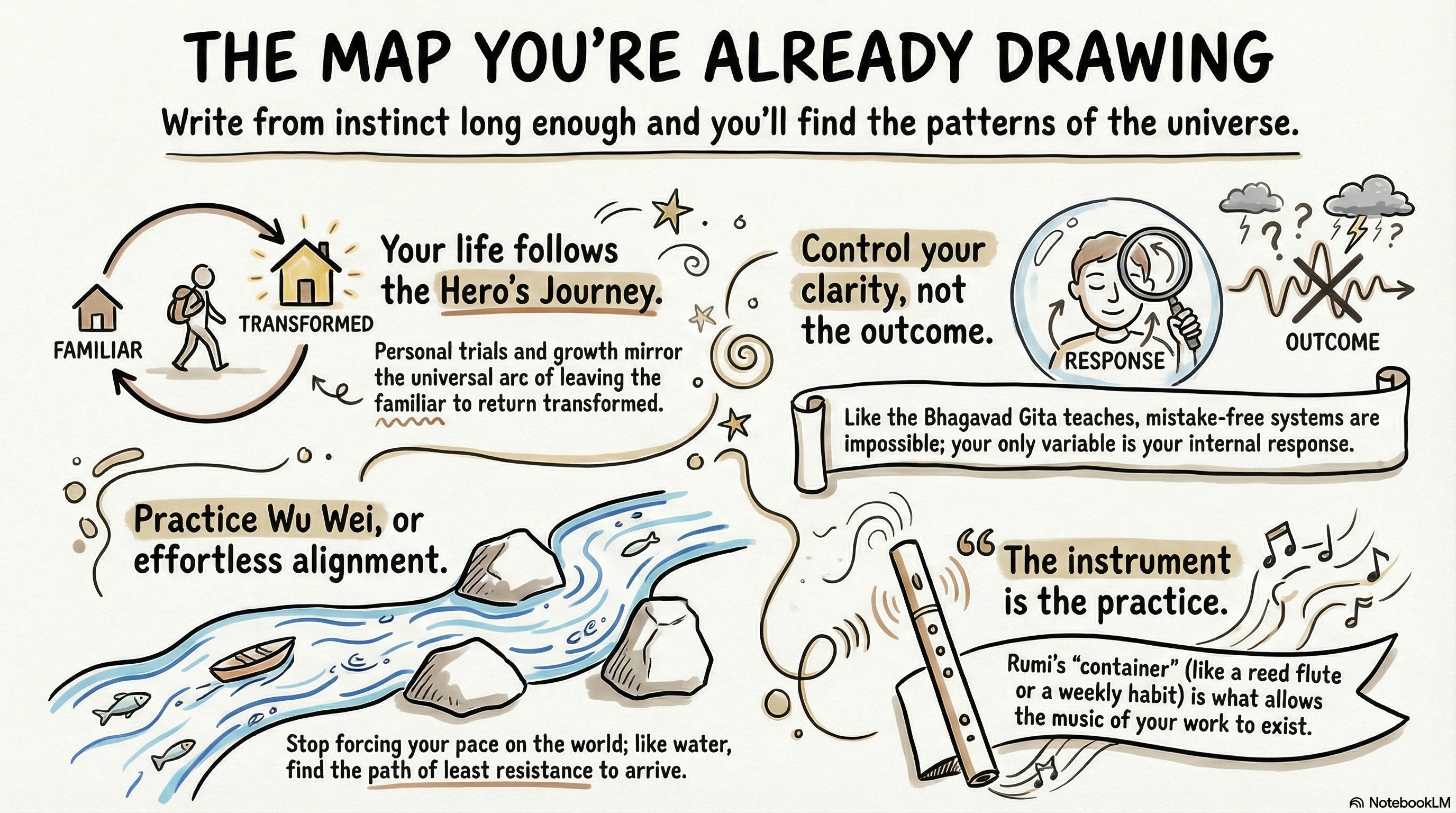
Write from instinct long enough, and the universe will show you the map you were already drawing.
Season One: complete. The question: ongoing.
On to the next commit.
📖 Go Deeper
These are the frameworks explored in this piece — and where to start if any of them sparked something.
Rumi Start with The Guest House — one of his most accessible poems, and the one that maps most directly onto this piece. Search “Rumi The Guest House” on YouTube for short readings that give you the feel of the work in under five minutes. From there, the opening eighteen lines of the Masnavi — the reed flute passage — are worth reading slowly, more than once. Coleman Barks’s collection The Essential Rumi is the best single English volume. → Rumi — Wikipedia → Search: Rumi The Guest House on YouTube
The Hero’s Journey — Joseph Campbell The best entry point isn’t the book. It’s the conversation. The Power of Myth — a six-part series filmed at George Lucas’s Skywalker Ranch in the last two summers of Campbell’s life — is one of the most watchable pieces of intellectual television ever made. Available on PBS.org and Amazon Prime. The companion book of the same name covers the full conversation. → The Hero’s Journey — Wikipedia → The Power of Myth — PBS
The Bhagavad Gita The Wikipedia article is a solid orientation — context, structure, key concepts. From there, the text itself is widely available free online. For audio, search “Bhagavad Gita explained English” on YouTube and find the voice and approach that resonates with you — there are many good ones. → Bhagavad Gita — Wikipedia → Search: Bhagavad Gita explained English on YouTube
Tao Te Ching — Lao Tzu / Wu Wei Alan Watts spent decades making Eastern philosophy accessible to Western minds. Search “Alan Watts — The Principle of Not Forcing” on YouTube — one of his most focused talks on wu wei. If you want to go further, his book Tao: The Watercourse Way is the most readable Western introduction to the text. → Wu Wei — Wikipedia → Tao Te Ching — Wikipedia → Search: Alan Watts The Principle of Not Forcing on YouTube
The Cynefin Framework — Dave Snowden The clearest written introduction is Snowden and Boone’s 2007 Harvard Business Review piece, “A Leader’s Framework for Decision Making” — still one of the most practically useful things HBR has ever published. → Cynefin Framework — Wikipedia → HBR: A Leader’s Framework for Decision Making
Thank you for reading The Weekly Commit through Season One. This series exists because you kept showing up — in inboxes, on podcasts, in the quiet of a commute or a lunch break. That matters more than the numbers ever will.
The Weekly Commit
Season One Episode Guide
Ten episodes. One arc. Read them in order, or start wherever you feel pulled.
- 001 Cooking with hooks & The Derby Redemption
Hash: 2026-01-19 | 01:11:00 UTC Status: Rebooting 🟢
- 002 The Republic of Code
Hash: 2026-01-26 | 04:44:00 UTC Status: Deploying...
- 003 The Gaffer & The Demon Hunters
Hash: 2026-02-01 | 04:04 pm Status: Refactoring...
- 004 When Proactiveness Turns Into Anxiety
Letting go of the need to control everything
- 005 The Stress Test
Pressure doesn’t change people. It reveals defaults.
- 006 The World Is Editable
Make your mark upon it.
- 007 “Just Ask AI”
A small sentence that changed our family dynamics.
- 008 "One Step at a Time"
The fastest way forward isn't your speed. It's theirs.
- 009 "Vibing"
Vibe Living to Vibe Coding. Staying curious still matters.
- 010 "Everything, Everywhere, All at Once" You are here
Season One finale. Nine commits. One question, asked nine different ways.