

Why are we going back to the moon now?
What a StarTalk explainer revealed about why we really went and why we're going back

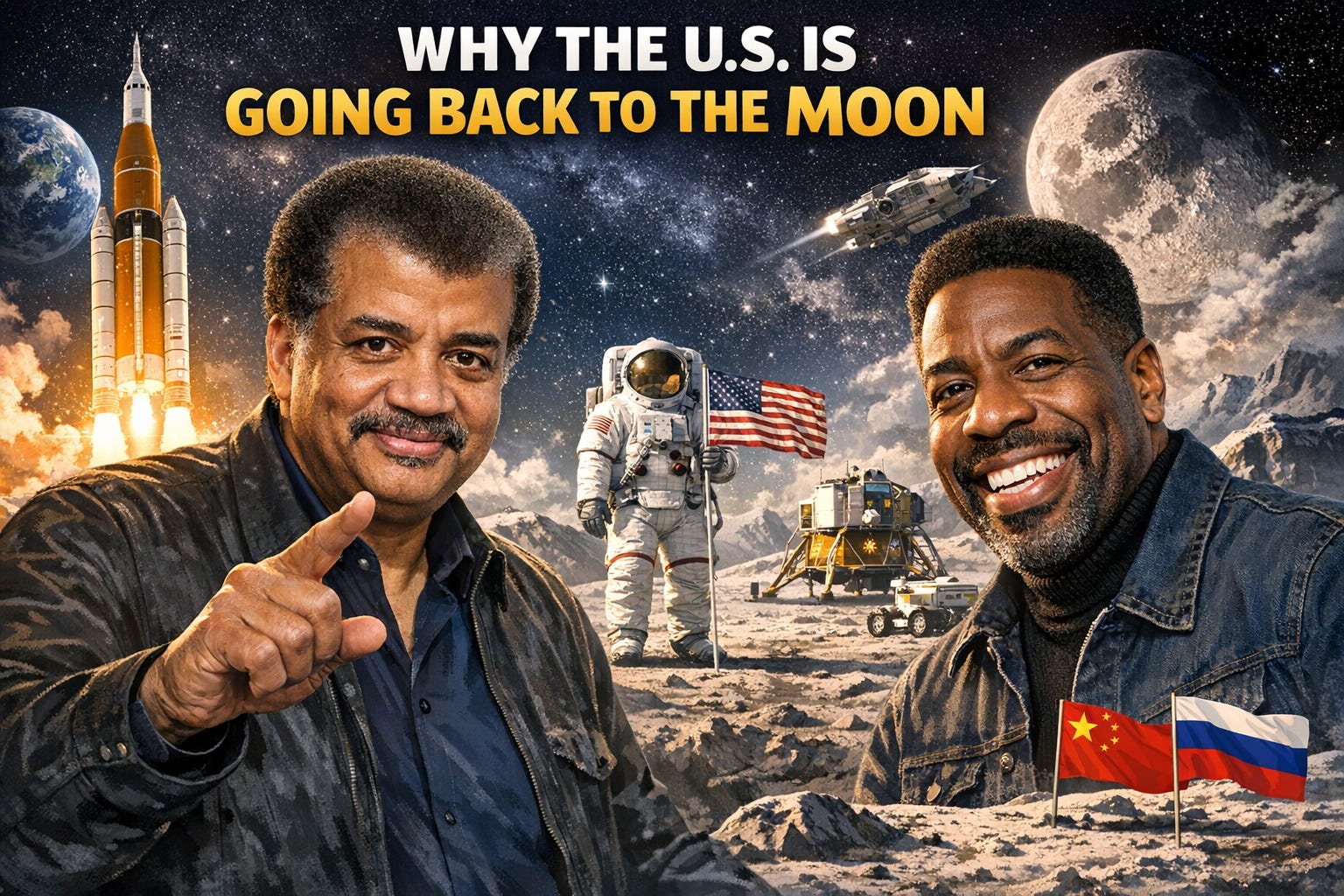
Why are we going back to the moon now? I kept asking that, and not finding a clean answer. Then I watched Neil deGrasse Tyson and Chuck Nice break it down on StarTalk and it turned out the answer was older than I expected.
It started with a race, not curiosity.
Six weeks after Yuri Gagarin orbited the Earth in 1961, Kennedy stood before Congress and chose the moon. The Soviets had already claimed the first animal in space, the first human in space. The US needed a win that couldn’t be disputed.
They got there. Six times.
Here’s the detail that stopped me: only one scientist ever walked on the moon. Harrison Schmitt, a geologist, flew on Apollo 17 — the final mission, December 1972. Every moonwalker before him came from a military or test pilot background. Schmitt was the only professional scientist. Once there were no Russians to race, the programme wound down almost immediately.
The science was almost incidental.
The return follows the same sequence.
In the 2010s, China announced plans to send taikonauts to the moon. The Artemis programme followed. Tyson points to this directly — the announcement, then the funding.
Tyson points out that NASA has outlasted every administration that touched it. The reason, he explains, is structural - the agency operates ten centres across eight states, making it deeply embedded in the fabric of the country. Artemis was initiated under Trump and continued under Biden without interruption.
The destination is specific and this is where it gets interesting.
The target isn’t just the moon. It’s the south pole.
Certain craters there sit in permanent shadow. The moon’s geometry means sunlight never reaches their floors. Over billions of years, comets have been depositing water ice into these cold traps.
That water has two direct uses, as Tyson lays out: drinking water for astronauts, and when split into hydrogen and oxygen — rocket fuel. The south pole becomes a potential staging point for missions to Mars and beyond.
China, Russia, and the US are all targeting this same region. Tyson describes it as a turf war in the making. The frozen floor of a shadowed crater, and three powers quietly pointing at it.
Artemis mirrors Apollo’s step-by-step logic.
Artemis 1 was un-crewed: a full test flight that splashed down cleanly. Artemis 2, which launched April 1, 2026, carries four astronauts on a ten-day lunar flyby: the first humans beyond Earth orbit since Apollo 17 in 1972. Artemis 3 will test lunar landers in Earth orbit. Artemis 4, targeted for 2028, is planned as the first crewed landing at the south pole.
The hardware has evolved alongside it. The new Space Launch System is roughly Saturn V-sized, with two solid rocket boosters carried over from the Space Shuttle design. The Orion capsule seats four instead of three — and something I found quietly remarkable — includes radiation insulation the original Apollo capsule never had. They flew to the moon without it, by design.
The legal framework has been updated too.
The original Outer Space Treaty was revised into the Artemis Accords, now signed by fifty to sixty countries, covering mutual aid and transparency in space. It’s the kind of document that reads like progress.
China and Russia declined and signed their own separate agreement instead. Tyson calls it a missed opportunity: lunar water as a shared resource rather than a race prize. Hearing him frame it that way, the gap between what happened and what could have feels sharper than the treaty language suggests.
The geopolitics answered my original question. But sitting with it afterwards, what stayed with me wasn’t the rivalry or the treaties.
It was the engineering.
Getting humans to the moon and back, remains one of the most extraordinary things our species has ever done. Whatever drove the decision to go, the people who built it, flew it, and are now building it again deserve to be marvelled at.
That part has nothing to do with politics.
Watch Video: “Why the US Is Going Back to the Moon” — StarTalk with Neil deGrasse Tyson and Chuck Nice, published April 2, 2026.