

The Weekly Commit #008: "One Step at a Time"
The fastest way forward isn't your speed. It's theirs.

Listen
Prefer audio? Listen on your platform of choice and keep the show notes here.
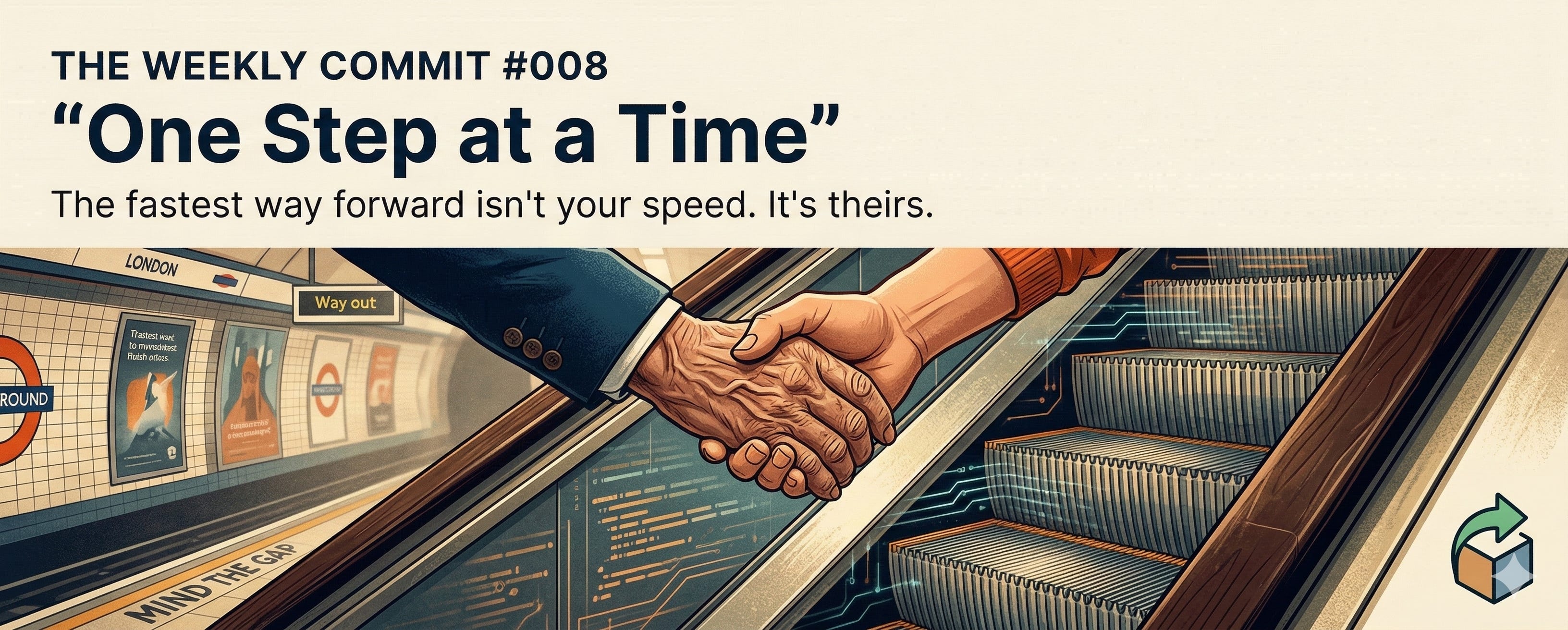
The escalator at the underground station moves fast. Not dangerously fast — just London fast. The kind of fast you stop noticing after the hundredth commute.
I was already half a step on in my head.
My mom stood at the edge, handbag gripped tight, watching the metal stairs fold into themselves and disappear into the floor below. People brushed past us. The station hummed with footsteps and announcements and that particular underground smell — old steel and recycled air.
“Come on,” I said. “We’ll miss the train.”
She didn’t move.
“Just step on.”
Nothing.
And then, one word:
“Wait.”
✳ The gap I didn’t see
That’s when it hit me.
I wasn’t seeing what she was seeing. To me, this was a conveyor belt — boring, automatic, already done a thousand times. To her, it was a machine moving faster than her legs wanted to trust. The steps kept coming, relentless, and she wasn’t ready.
I wasn’t being patient. I was being blind.
My rhythm wasn’t her rhythm. My “obvious” wasn’t hers. And no amount of “just step on” was going to close that gap — because the gap wasn’t about capability. It was about readiness. About the fact that my mind and her mind were standing in two different places, even though our bodies were side by side.
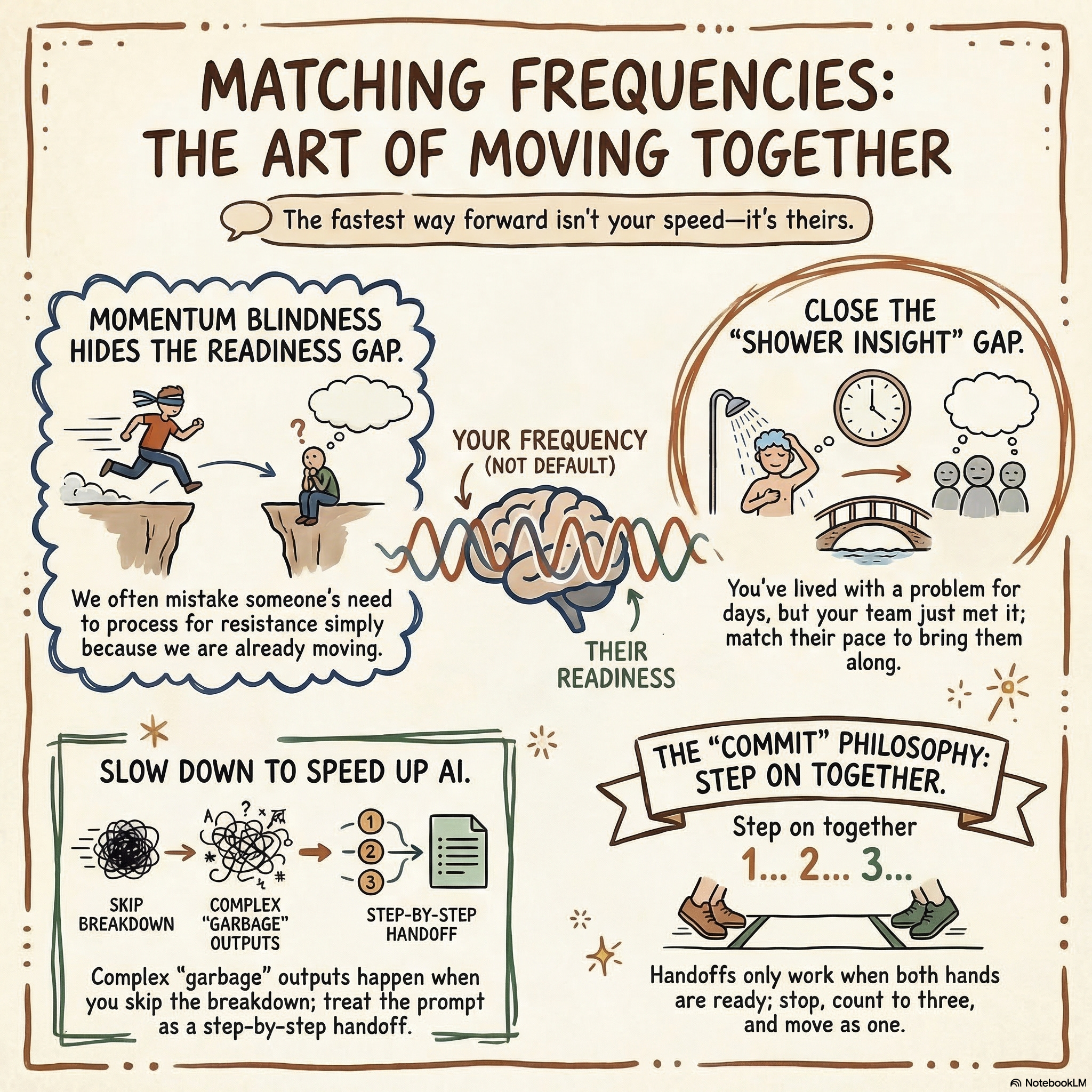
Sometimes the person next to you isn’t hesitating. They’re processing. And you’re so deep in your own frequency that you mistake their pause for resistance.
🧭 The pattern
Once you see it, you see it everywhere.
In teams — you’re three decisions ahead, wondering why they’re still asking questions about step one. But they’re not slow. They just haven’t made the mental leaps you made in the shower two days ago. You’ve been living with this problem. They just met it.
In family — you’ve processed a decision, moved on, and expect everyone to be where you are. But they’re still standing at the edge of the escalator, watching the steps disappear. You’ve already stepped on. They haven’t.
In AI — and this one surprised me — the same pattern shows up when you’re working with a model. You dump a complex, multi-layered prompt. Context, constraints, examples, edge cases — all in one breath. And then you wonder why the output is garbage.
But the model isn’t broken. You just skipped the breakdown.
You assumed your context was shared. It wasn’t.
🤖 The AI mirror
I’ve started noticing how I prompt differently when I slow down.
When I rush, I write prompts the way I think — compressed, full of assumptions, layered with context I’ve been holding for days. It makes perfect sense to me. It makes no sense to the model.
When I slow down, I break it into steps. I say: here’s what we’re doing. Here’s why. Here’s the first piece. Let’s get that right before we move on.
And suddenly, the output is sharper. The model follows. The collaboration works.
It’s the same lesson the escalator taught me: the handoff matters more than the speed.
AI doesn’t know what you know. It’s standing at the edge, waiting for you to count to three. If you rush, you leave it behind. If you pace yourself — break it down, go one step at a time — you arrive together.
The irony isn’t lost on me: a machine is teaching me how to be more patient with humans.
🔁 Back at the escalator
I stopped.
Took a breath. Let the crowd flow around us.
I reached out and took her hand.
“Okay. On three.”
She looked at me. Nodded.
“One… two… three.”
We stepped on together.
The escalator didn’t care. It kept moving at the same relentless pace — that London pace — indifferent to whether we were ready or not. But she was on it now. And that was the only thing that mattered.
Sometimes the universe slows you down on purpose. Not to frustrate you. To remind you that the person beside you is not inside your head. That your frequency is not the default frequency. That the fastest path forward isn’t a sprint — it’s a handoff.
And handoffs only work when both hands are ready.
📌 Commit
The fastest way forward isn’t your speed. It’s theirs. Slow down. Count to three. Step on together.
On to the next commit.