🎶 Why Spotify’s Lossless Audio Matters and How Sound Becomes Math
From concert halls to code, the hidden story behind digital sound quality
Spotify just confirmed what many music lovers have been waiting years for: lossless audio is finally coming to Premium subscribers — at no extra cost.
On the surface, this might sound like just another streaming upgrade, akin to going from HD to 4K video. But Spotify’s move is also an invitation to ask a bigger question:
👉 What exactly is lossless sound?
👉 What do we sacrifice when we compress music?
👉 And what changes when we keep it all?
To answer those, we need to step into the fascinating science of how sound travels from a concert hall to your headphones.
From Concert Waves to Code
Imagine yourself at a live performance. A guitar chord resonates. A singer leans into the microphone. The air vibrates with continuous, analog waves of sound.
To preserve this moment digitally, we need to convert those waves into something a computer understands: 1s and 0s.
Here’s how it works:
Sampling: The sound wave is sliced into tens of thousands of “snapshots” per second.
Sample Rate: CD quality uses 44,100 snapshots every second.
Bit Depth: The precision of each snapshot, like resolution in a photo.
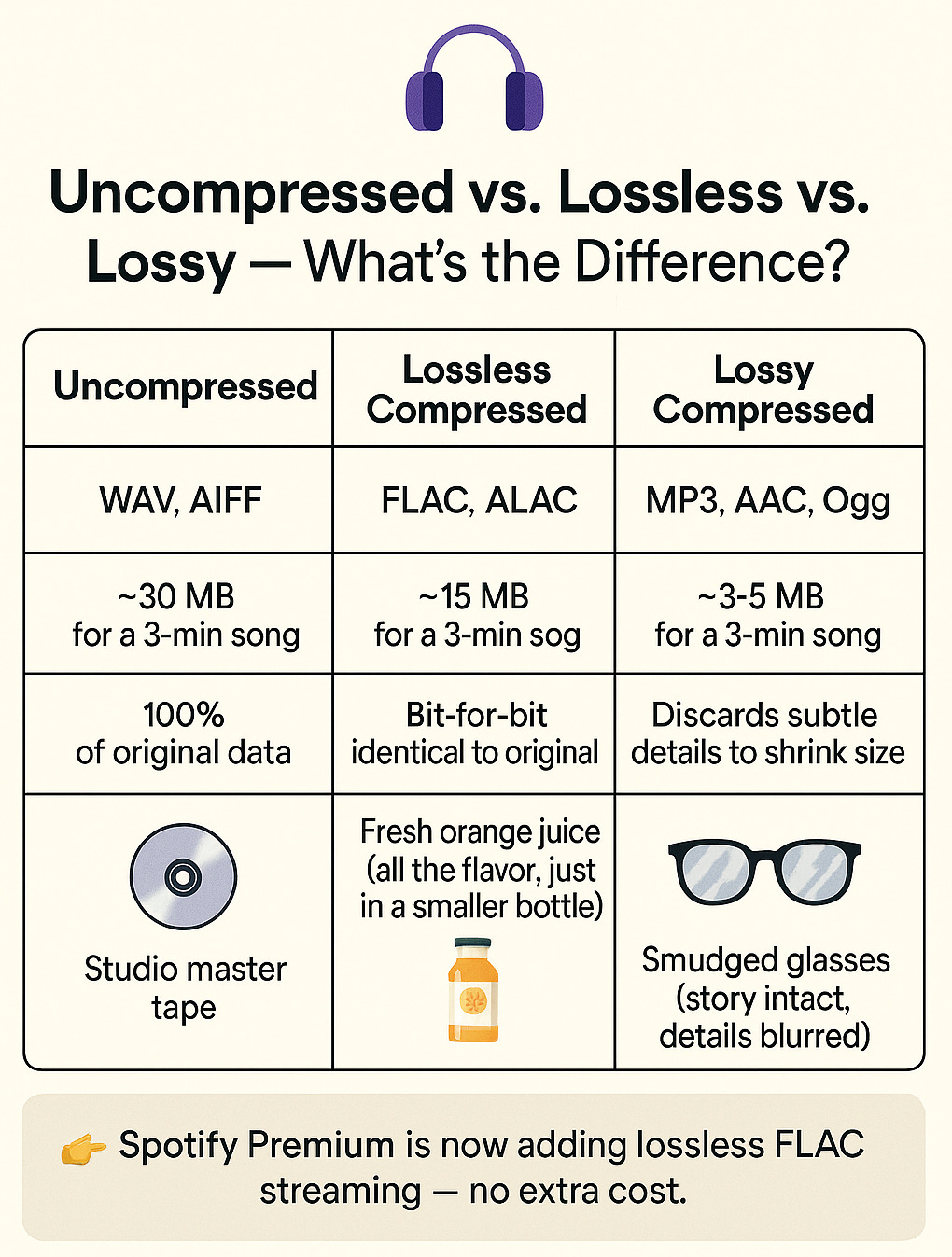
Together, they form a digital map of the original wave. A three-minute track captured this way can easily weigh 30 MB.
Play it back, and a digital-to-analog converter (DAC) stitches the snapshots back into a continuous wave, which drives your speakers and fills the room again.
Done right, the process can sound indistinguishable from the original performance.
Why Compression Was Necessary
But here’s the problem: those large files were a burden. Early iPods, CDs, and fragile internet connections couldn’t carry millions of 30 MB tracks.
The solution was lossy compression — formats like MP3, AAC, or Ogg. Engineers applied psychoacoustics, removing details our ears are less likely to notice: very high frequencies, or faint sounds masked by louder ones.
A three-minute track shrank from 30 MB to 3 MB. Suddenly, you could carry 1,000 songs in your pocket. Streaming was possible. Music became ubiquitous.
The tradeoff? Some details were gone forever.
“Lossy formats give us the story. Lossless lets us hear the storyteller breathe.”
Lossy vs. Lossless: Everyday Analogies
So what’s the difference between lossy and lossless formats in practice? Here’s where everyday life helps.
🥤 Food Analogy
Lossless: Freshly squeezed orange juice — every drop, every bit of pulp, all the flavor intact.
Lossy: Boxed juice from concentrate — still orange juice, still refreshing, but some subtleties are missing.
👓 Vision Analogy
Lossless: Looking through clean, clear glasses — every edge sharp, every detail visible.
Lossy: Looking through smudged lenses — the world still recognizable, but the fine textures are blurred.
That’s essentially the tradeoff: lossy formats preserve the big picture but discard some of the subtler flavors of sound. Lossless keeps it all.
Spotify’s Announcement in Context
Apple, Tidal, Amazon, and Qobuz have offered lossless streaming for years. Spotify — the market leader — held back, promising a “HiFi” tier as far back as 2021 but delaying rollout.
Now, in 2025, it’s here: Spotify Premium subscribers will get lossless FLAC streaming at no extra cost.
It’s not a revolution. You won’t suddenly hear night-and-day differences on the train with AirPods. But it is a recognition that the bar for sound quality has been raised — and that “good enough” isn’t the only option anymore.
“Lossless isn’t louder — it’s closer. Closer to the breath before the note, the shimmer of a cymbal, the echo of a studio.”
Can You Really Hear the Difference?
Here’s the controversial part:
On cheap earbuds or in noisy environments, the difference between a high-bitrate MP3 and a lossless file may be negligible.
But on good headphones, in a quiet room, you might notice subtleties: the shimmer of a cymbal, the trailing echo of a piano, the faint breath before the chorus.
Lossless isn’t about volume. It’s about fidelity — not just to sound, but to the artist’s intent.
Why It Matters
Most people will continue streaming casually, unaware of the difference. And that’s fine — the emotional punch of a favorite song survives in any format.
But there’s something almost philosophical about lossless audio. In an era where everything is compressed, optimized, and algorithmically curated, hearing everything the artist recorded — without shortcuts — feels rare, even radical.
Lossless offers closeness: the ability to step just a little nearer to the concert hall, to the studio, to the human moment when the sound was made.
“In an age of compression and algorithms, hearing everything an artist recorded feels almost radical.”
The Sound of Choice
Spotify’s announcement isn’t promising miracles. It’s promising choice.
Behind every stream of 1s and 0s lies something fragile and human: a wave of air, once set in motion by an artist, now reconstructed in your living room.
Your playlist was always pure math.
Now, it can sound a little more like magic. ✨
👉 What about you — will you give Spotify’s lossless streams a try, or do you think “good enough” has already earned its place in our ears?
💬 Share your thoughts in the comments — I’d love to know if you’ve ever noticed the difference between lossy and lossless sound.