What Got You Here Can Take You Forward - If You Know What to Keep and What to Change
Principles Don’t Expire. Methods Do
We’ve all heard Marshall Goldsmith’s famous line: “What got you here won’t get you there.”
It’s sharp, provocative — and widely quoted in leadership circles.
But here’s the thing: I respect the insight, yet I don’t fully agree with taking it as a blanket statement. Because in reality, some things do carry you forward.
The curiosity that drove you to learn, the resilience that carried you through setbacks, the integrity that shaped your reputation - these aren’t meant to be discarded. They are the roots that support your next stage of growth.
The challenge isn’t to throw everything away. It’s to distinguish between:
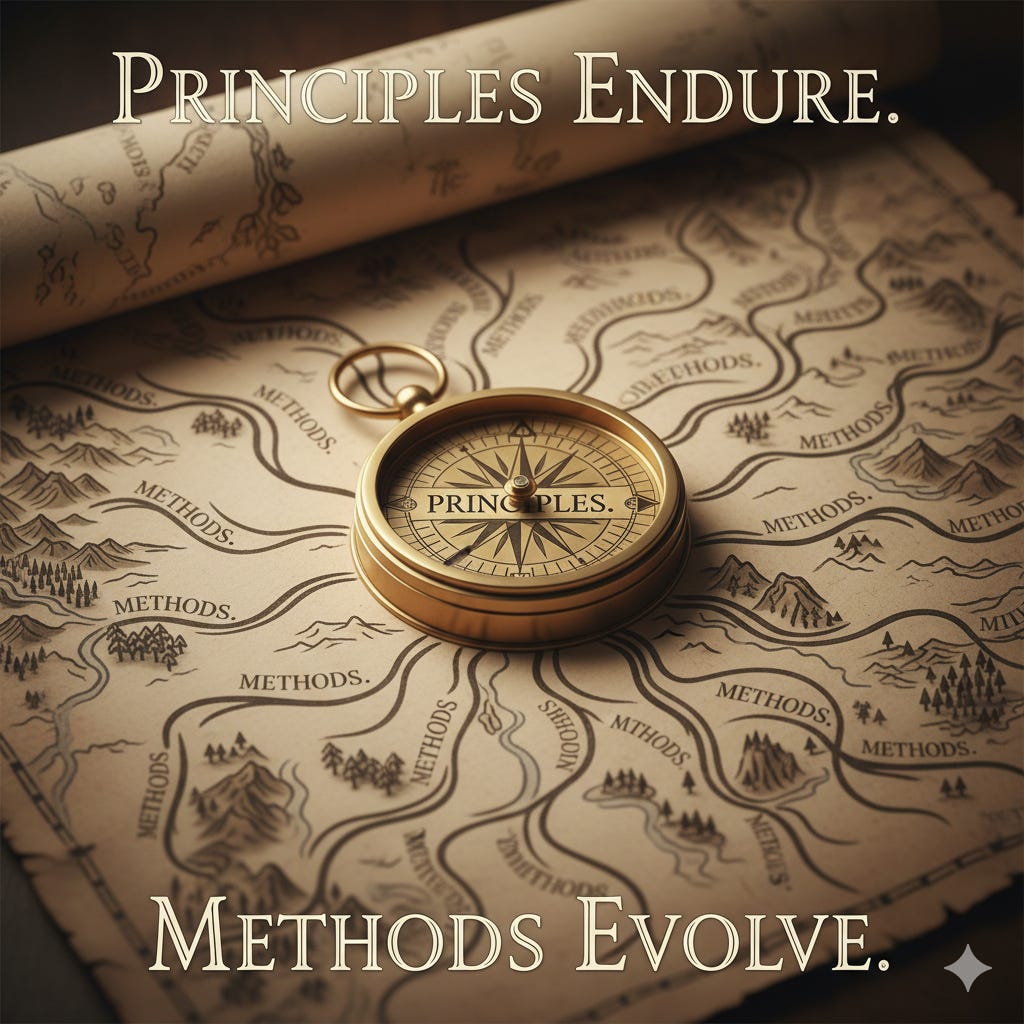
Principles — what endures.
Methods — what must evolve.
What Goldsmith Gets Right
Goldsmith’s warning is valuable: the same behaviors that earn success at one stage may limit you at the next.
As an individual contributor, success often means being the best doer.
At leadership levels, success depends on empowering others.
So yes — methods must evolve.
Where It Feels Incomplete
But not everything that got you here becomes obsolete.
Core principles — integrity, curiosity, adaptability, resilience — endure.
They are the anchor that allows you to adapt tactics without losing yourself.
This is where Jim Collins and Brad Stulberg provide richer language.
Collins & Stulberg on the Balance
Jim Collins describes the duality as “Preserve the Core / Stimulate Progress.” Visionary organizations keep their values and purpose constant, while continually renewing strategy, culture, and methods:
“The only truly reliable source of stability is a strong inner core and the willingness to change and adapt everything except that core.”
Brad Stulberg, in Master of Change, calls it “rugged flexibility” — being firm in your principles, flexible in how you live them. He writes:
“Routines are how you manifest your core values.”
The routine may change, but the values give it meaning.
Both echo the idea: principles endure, methods evolve.
Case Studies — People
Satya Nadella (Microsoft)
Enduring principle: curiosity and empathy.
Evolving method: reframing culture from “know-it-all” to “learn-it-all.”
As Nadella put it: “Don’t be a know-it-all. Be a learn-it-all.”
Result: Microsoft’s culture reset paved the way for a cloud-first, AI-first resurgence.
Steve Jobs (Apple, Pixar, NeXT)
Enduring principle: technology at the intersection of the humanities.
Evolving method: expressing that through different industries — the Macintosh, Pixar films, iPhone.
As he declared at the iPad 2 launch: “It’s technology married with liberal arts, married with the humanities.”
Howard Schultz (Starbucks)
Enduring principle: coffee as community and quality.
Evolving method: in 2008, Schultz closed all U.S. stores for retraining to re-anchor quality; later, Starbucks embraced mobile ordering and loyalty apps to extend the same principle digitally.
Case Studies — Companies
Netflix (Reed Hastings)
Enduring principle: customer convenience.
Evolving method: DVDs by mail → streaming in 2007 → original content like House of Cards in 2013 → global expansion and beyond.
Amazon (Jeff Bezos)
Enduring principle: customer obsession.
Evolving method: books → “everything store” → AWS → Alexa.
As Bezos wrote in his 1997 letter: Amazon is built on “relentless focus on customer experience” — and in his 2016 letter: “True customer obsession is the foundation of Day 1.”
The Balanced Mantra
Goldsmith was right to provoke us. But Collins and Stulberg help us see the fuller truth:
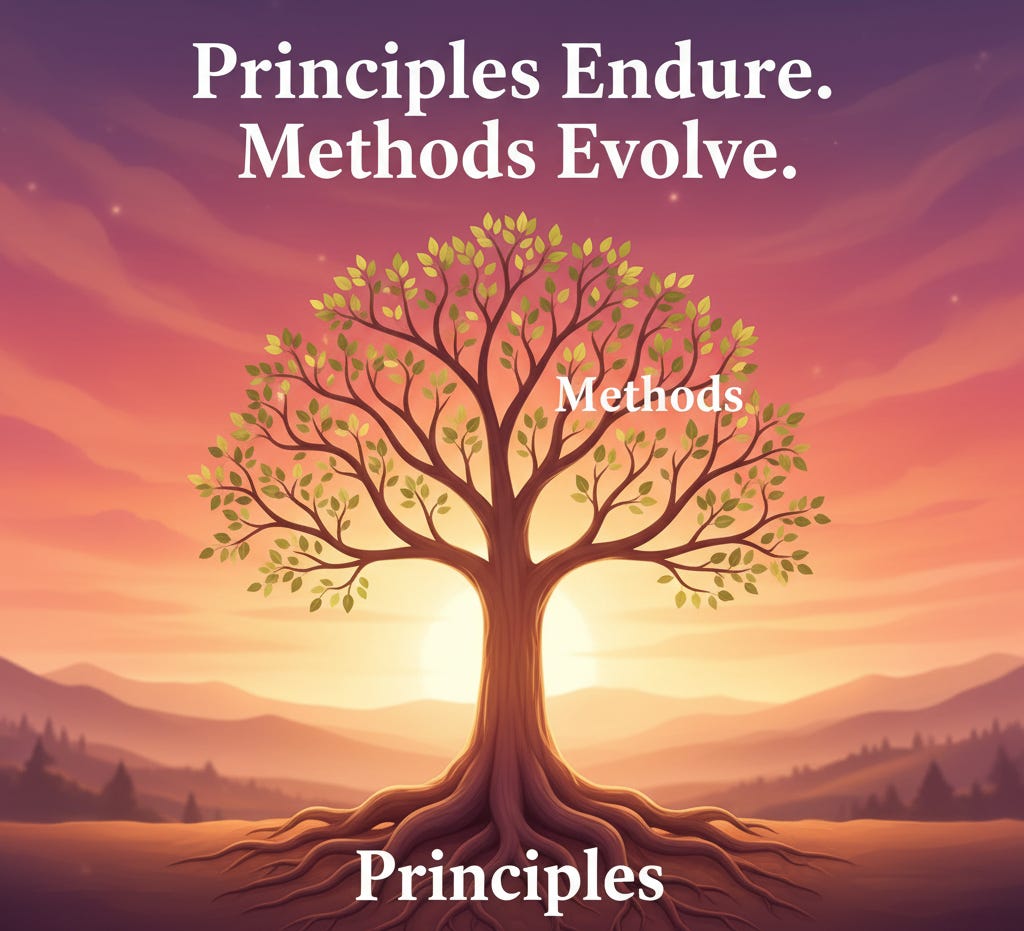
Principles endure.
Methods evolve.
Roots stay. Branches grow.
Closing
The next stage of your journey rarely asks you to discard what got you here. Instead, it asks:
👉 Which habits should I carry forward?
👉 Which ones should I adapt?
👉 Which ones should I leave behind?
Your turn:
Have your principles carried you forward — or did you have to reinvent yourself entirely at each stage?