The Weekly Commit #004: When Proactiveness Turns Into Anxiety
Letting go of the need to control everything
Listen
Prefer audio? Listen on your platform of choice and keep the show notes here.
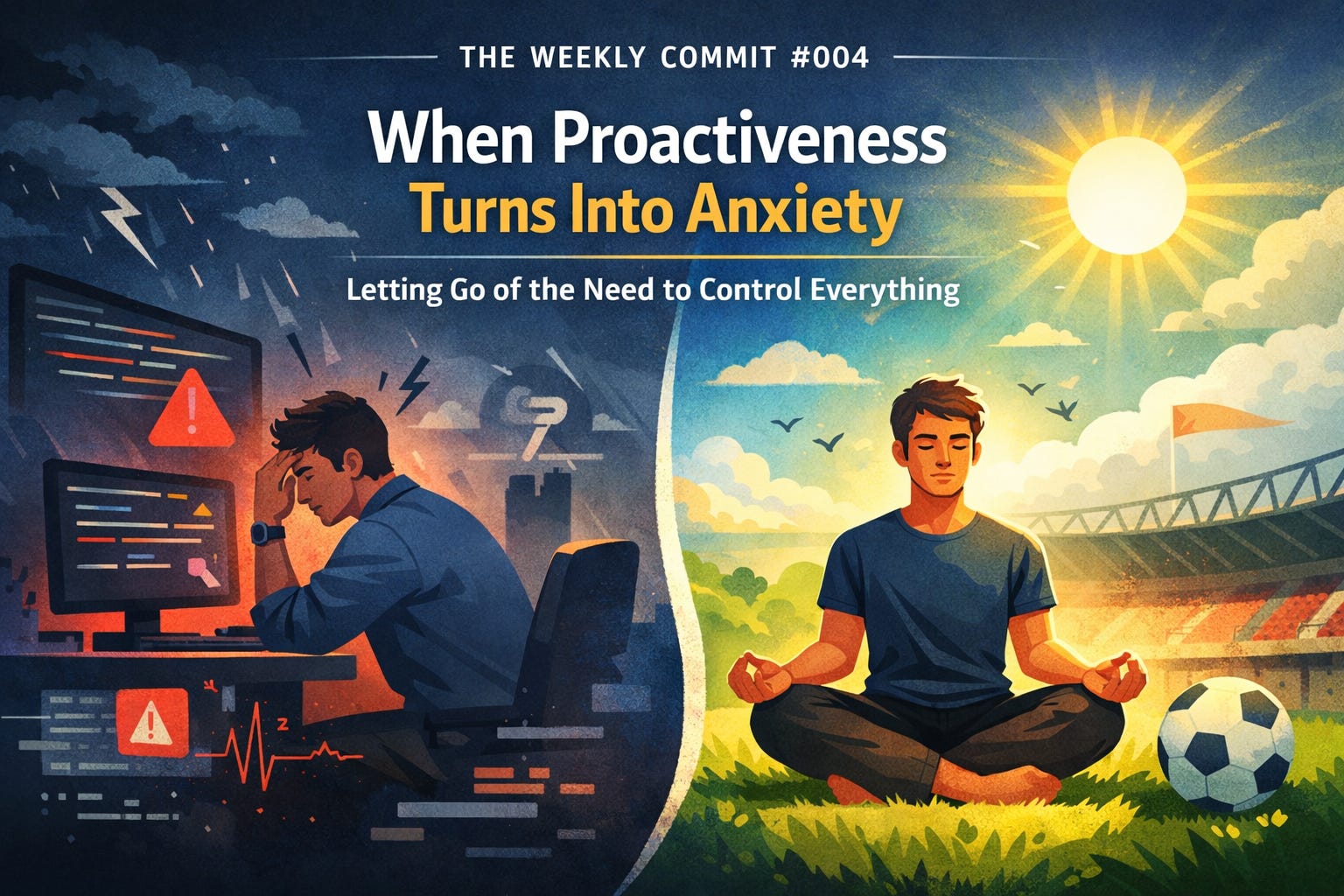
This commit captures a shift I didn’t fully notice while it was happening, but became clear in hindsight. It’s a record of a pattern I lived with for years, and a decision to carry it forward differently.
🚀 Feature Ideas (The Main Story)
For a long time, I believed that being proactive meant being constantly alert.
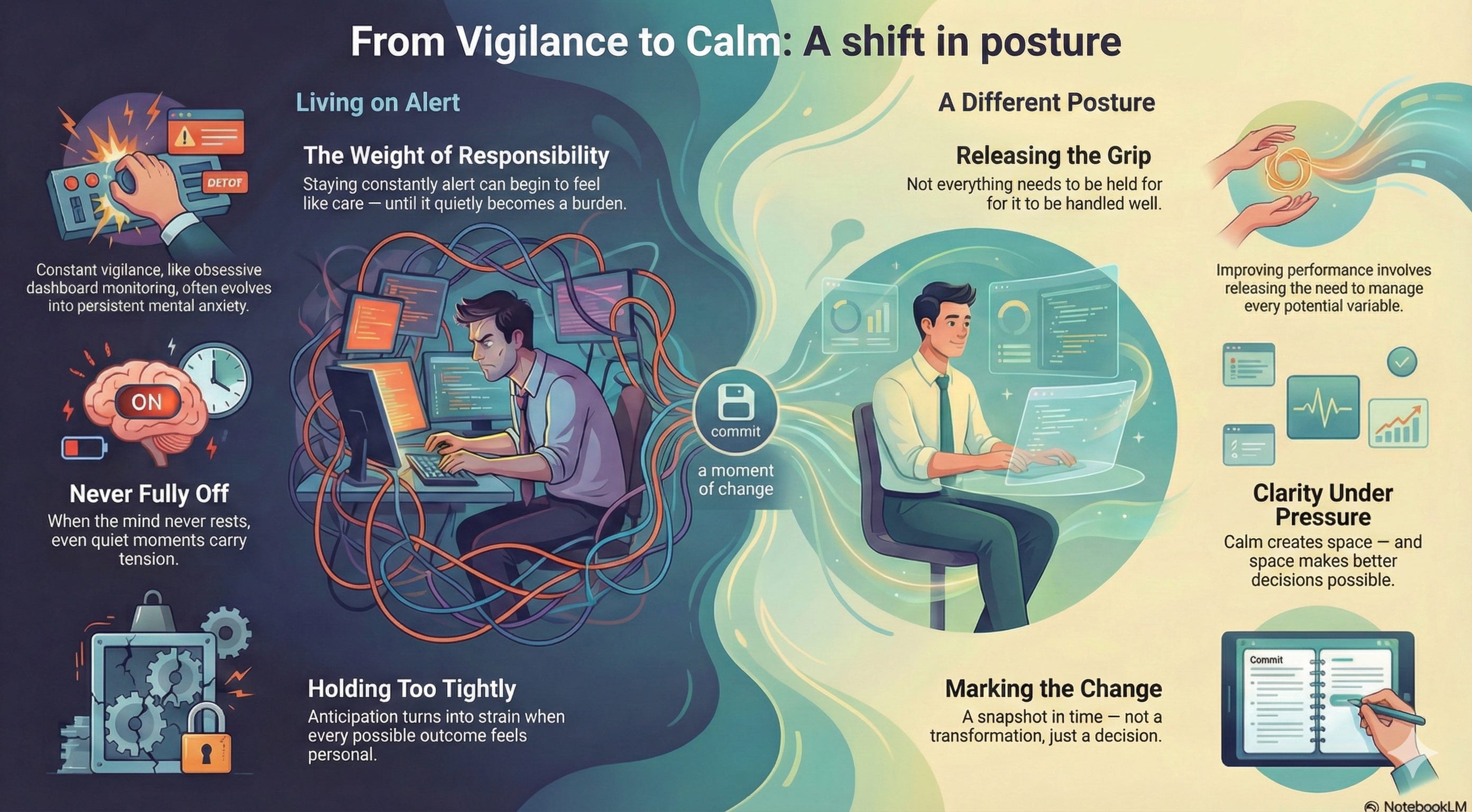
As a software engineer, that often looked like watching dashboards closely, anticipating production alerts, and mentally preparing for things to go wrong before they actually did. I told myself this was responsibility - that this was what caring deeply about the work required.
Over time, that posture hardened into habit.
Especially during the COVID years, between 2020 and 2023, the need to stay ahead of everything became overwhelming. Work and life blurred into one continuous state of readiness. Even when systems were stable, my mind wasn’t. Calm felt temporary. Stability felt fragile.
Looking back, I can see that what I was practising wasn’t just proactiveness.
It was anxiety.
That constant vigilance took a toll. It made problems feel heavier than they needed to be. It slowly drained the joy out of the work. I found myself thinking about escape — not dramatically, but quietly — imagining different paths, different roles, anything that might reduce the tension. But responsibilities don’t disappear just because you’re tired. And even if they did, running away wouldn’t have addressed the real issue.
The uncomfortable truth is this: no amount of anticipation prevents issues entirely. Systems fail. Things break. Uncertainty is part of the job.
What matters is not how early you spot a problem, but how you respond when it arrives.
There is a difference between being prepared and being perpetually tense. In incident response and on-call culture, constant vigilance is often rewarded — watching dashboards, anticipating failures, staying mentally “on” even when nothing is happening. It feels like ownership.
But when proactiveness is driven by fear, it slowly turns into a form of self-surveillance. You’re always scanning. Always bracing. Over time, even quiet moments start to feel unsafe.
📚 Docs & Inputs (Dependencies)
This week, the same idea showed up in very different places.
Watching Manchester United play at Old Trafford was one of those moments that stays with you. Beyond the result, what stood out was how the team carried themselves. The skills weren’t suddenly different. The techniques weren’t radically new.
What had changed was posture.
There was less fear of mistakes and more freedom in how they played. It felt like watching what happens when a system stops trying to control everything and starts trusting itself.
I captured a small part of that experience here:
Around the same time, I watched Taylor Swift’s Opalite music video:
One line stayed with me.
“You have to make your own sunshine.”
Not as a slogan, but as a practice. Calm doesn’t arrive once everything is finally under control because that moment never really comes. Calm is something you cultivate while uncertainty still exists.
Across work, sport, and music, the same pattern repeated itself: performance improves not when you tighten control, but when you loosen it.
🐛 Bug Fixes (Life / Work Hacks)
The bug I noticed this week was subtle, but familiar.
I was equating calm with carelessness, and tension with responsibility. I was staying mentally braced, even when there was nothing to brace against.
The fix isn’t a switch you flip. It’s a posture you practise.
I’m learning to pause instead of pre-empt. To trust that I can handle issues when they arise, instead of living inside every possible failure scenario ahead of time. Staying calm doesn’t mean caring less, it means thinking more clearly when it matters.
In real incidents, it’s often the calmest person in the room who creates clarity, not the most anxious one.
🧠 Raw Dump / Scratchpad
A few thoughts that stayed with me this week:
Calm systems recover faster.
Anxiety doesn’t prevent failures, it just makes them heavier.
You don’t control outcomes, only responses.
Responsibility doesn’t require panic.
These aren’t conclusions. They’re reminders.
⚙️ How to use this (The Workflow)
This Weekly Commit is a snapshot - a record of a change in thinking.
Not a lesson.
Not advice.
Just an honest state update.
I’m carrying this forward into the next week: staying attentive without staying tense, trusting that calm is not a weakness, and remembering that letting go of the need to control everything doesn’t mean caring less, it means trusting more.
On to the next commit.