The Stranger Things Formula: Reverse Engineering the Upside Down
Decoding the Agile Storytelling, Science Checks, and Scooby-Doo Dynamics
Listen
Prefer audio? Listen on your platform of choice and keep the show notes here.
🎧 You can listen to the audio companion via the player above, or subscribe on Apple Podcasts and Spotify to listen on the go.
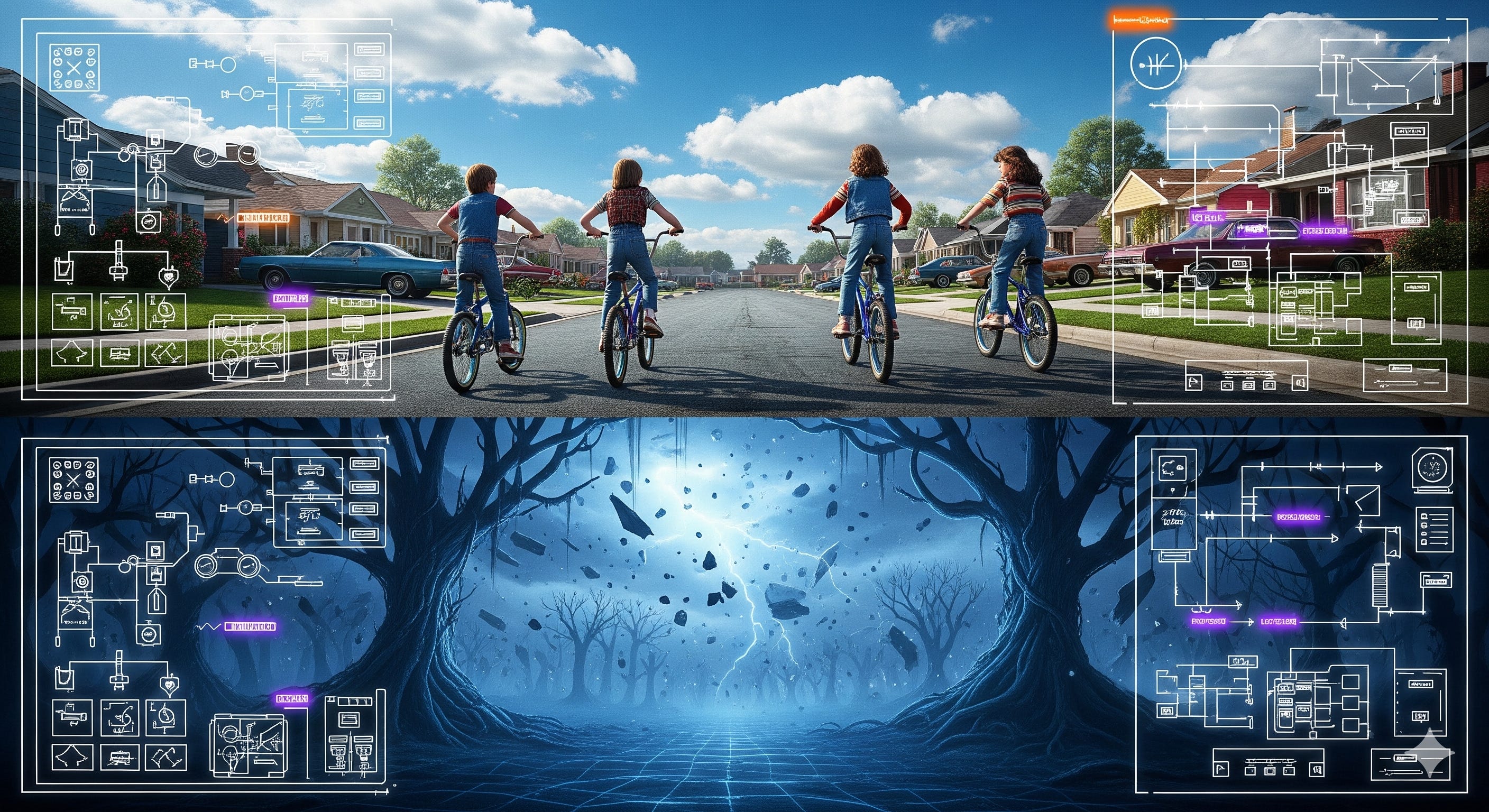
I have a confession: I don’t do horror.
For years, Stranger Things sat on my Netflix watchlist, gathering digital dust. The hype was undeniable, but I’ve always avoided movies or series that tap too deeply into the dark side. I prefer my entertainment without the lingering anxiety.
But with the cultural zeitgeist peaking around the Season 5 finale this past January 1st, 2026, I decided to run a personal experiment. I call it the “Two-Episode Leap of Faith.” I promised myself I would watch the first two episodes without judgment. If it was too dark, I’d bail.
Spoiler alert: I didn’t bail. I was hooked.
I ended up binging the entire saga just in time to catch the finale live with the rest of the world. Now, looking back at Hawkins, Indiana, I realize that Stranger Things isn’t really a horror show. It’s an engineering marvel of nostalgia, blending the DNA of my childhood favorites into something entirely new.
Here is why I believe we all connected with it, and why—if you are a Harry Potter or Scooby-Doo fan—you need to watch it.
The “Scooby-Doo” Effect
In hindsight, the reason I survived the scary parts was that the show’s skeleton is pure Scooby-Doo.
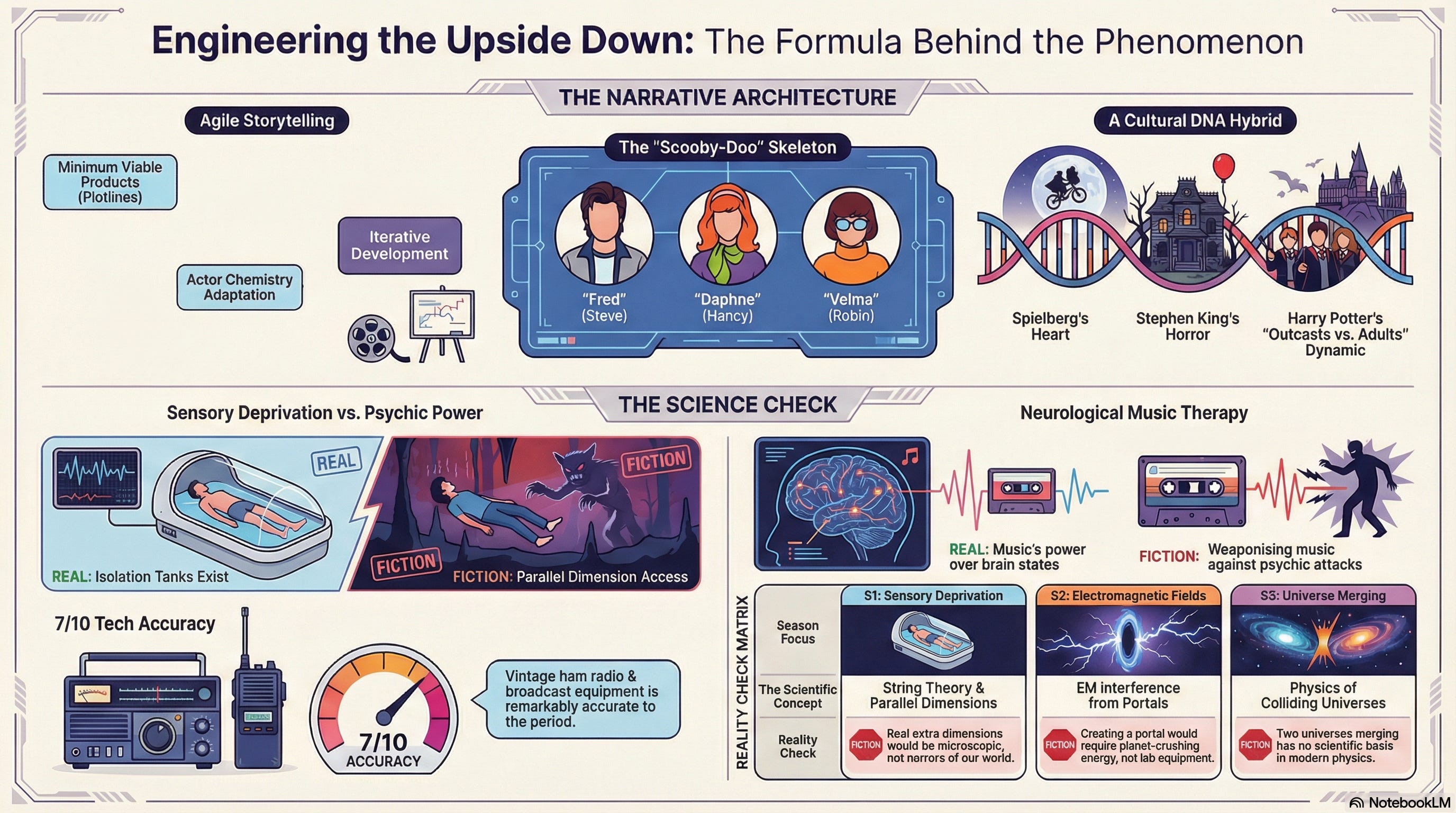
Strip away the CGI monsters, and you have a group of distinct archetypes solving a mystery. You have the “Fred” (Steve Harrington), the “Daphne” (Nancy), and the “Velma” (Robin/Dustin). They split up, they look for clues, and they build traps.
But it goes deeper. The show taps into that Harry Potter vein—a group of outcasts facing a supernatural threat that the adults are largely blind to. It even mirrors Game of Thrones (specifically the White Walkers) in how it presents an existential, creeping icy threat from a “North” (or in this case, the “Down”).
Agile Storytelling: A Software Engineer’s Perspective
As an engineer, I found myself fascinated by the making of the show. I dove into the behind-the-scenes content on YouTube and the “One Last Adventure” featurette.
What struck me was the humility of the Duffer Brothers. They were incredibly open about their process. They didn’t have every single plot point locked down from day one. Instead, they brainstormed story ideas while filming.
In the software world, we call this Agile Development.
They were essentially building “Minimum Viable Products” (MVPs) of the storyline, testing them, and iterating as they finalized the design. They allowed the chemistry of the actors and the constraints of production to reshape the code of the story. It wasn’t a rigid Waterfall project; it was iterative, adaptive engineering.
The Engineer’s Guide to the Upside Down (Spoiler-Free)
If you are ready to take the leap, here is what you are getting into—along with a reality check on the science behind the fiction.
The Core Premise
Think 1980s adventure where Scooby-Doo meets Stephen King with Spielberg’s heart. Kids in Hawkins, Indiana, battle threats from an alternate dimension called the Upside Down.
Season 1: The Vanishing
The Hook: Will Byers disappears. His friends find Eleven, a girl with telekinetic powers escaping government experiments.
Science Check: The show leans on the concept of sensory deprivation tanks (real) to access psychic powers (not real). The parallel dimension concept borrows from String Theory, though real extra dimensions would likely be microscopic, not a mirror version of your town.
Season 2: The Mind Flayer
The Hook: A shadow monster possesses Will. Eleven discovers more about her past.
Science Check: The show depicts electromagnetic interference when the “gate” is active. While EM fields interfere with electronics, creating an actual dimensional portal would require planet-crushing energy, not just some lab equipment in a basement.
Season 3: The Russian Conspiracy
The Hook: The Cold War comes to the mall. Russians try to reopen the gate, and the monster seeks to build a physical army.
Science Check: Dustin’s ham radio setup is a beautiful piece of 1980s tech nostalgia. However, physically, the underground radio transmissions shown wouldn’t quite work that way through that much earth.
Season 4: Vecna Revealed
The Hook: A new, psychological villain named Vecna begins targeting teens. We learn the dark history of Hawkins Lab.
Science Check: This season deals with music affecting brain states. While music therapy is real and powerful for neurological recall, weaponizing it to stop a psychic attack is pure Hollywood—but it makes for incredible television.
Season 5: The Final Showdown
The Hook: The walls between worlds collapse. Hawkins merges with the Upside Down, and the original party must unite to seal the threat forever.
Science Check: The vintage radio equipment used in the finale is surprisingly accurate (a solid 7/10 for 1980s broadcast tech). However, the physics of two universes merging has no scientific basis—but purely from a narrative standpoint, it’s the logical conclusion to the story.
The Verdict
Stranger Things works because it respects the intelligence of its characters. The kids aren’t just props; they are problem solvers. They use science, logic, and Dungeons & Dragons lore to make sense of the impossible.
If you loved the group dynamics of Scooby-Doo, the “Chosen One” vs. “Dark Lord” narrative of Harry Potter, or just appreciate a well-engineered story that iterates and improves with every season, take the leap.
Just make sure you keep the lights on.
Thanks for reading Engineered by Gaurang. Subscribe for more thoughts on tech, storytelling, and the engineering of everyday life.