The Long Game: Why You Should Watch "The Thinking Game"
How video games, a London lab, and decades of patience led to a Nobel Prize.
🎧 New Feature: I’ve added an audio companion to this newsletter! You can listen to the AI-generated breakdown via this post, or subscribe on Apple Podcasts and Spotify to listen on the go.
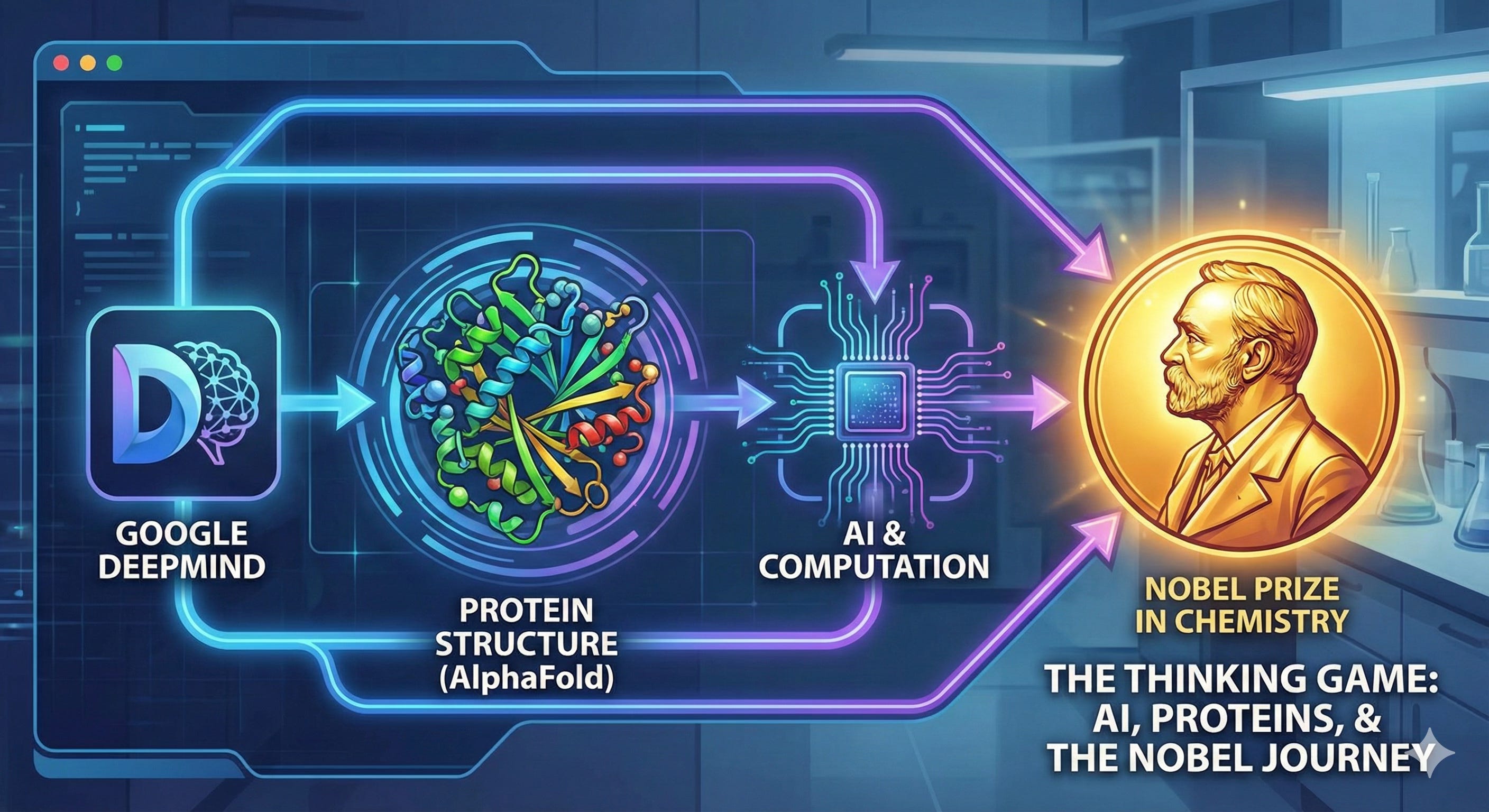
If you follow the news, you probably saw the headline: Demis Hassabis and the DeepMind team won the 2024 Nobel Prize in Chemistry.
It is a monumental achievement. They effectively “solved” the Protein Folding problem - a 50-year-old biological puzzle that holds the key to understanding diseases and creating new medicines.
But headlines are often deceiving. They make success look like a singular event - a lightning strike of genius.
I recently watched the documentary The Thinking Game, which chronicles the real story behind DeepMind. It wasn’t a lightning strike. It was a decades-long obsession. It is a story about the bridge between “play” and “science,” and it is one of the most inspiring things I have watched in a long time.
Whether you are a software engineer, a creative, or just someone curious about how the future is built, here is why you need to watch it—and what we can all learn from Demis Hassabis’s approach.
1. “Play” is Serious Research
One of the most surprising things about the film is where it starts. It doesn’t begin in a sterile lab; it begins with chess boards and video games.
Demis was a child chess prodigy and a video game developer (working on classics like Theme Park). To the outside observer, games look like entertainment. But to Demis, they were the perfect “sandbox.”
The documentary shows how DeepMind trained their AI not on complex scientific data initially, but on Atari games, StarCraft, and eventually the ancient board game Go.
The Lesson: We often think “serious work” requires “serious environments.” DeepMind proved that wrong. They used games as a safe, data-rich environment to teach an AI how to learn. They allowed the system to fail millions of times in a game so it wouldn’t fail when it mattered in the real world. Innovation often requires a playground before it gets a laboratory.
2. The Geography of Focus
There is a fascinating moment in the documentary regarding location. In the tech world, the gravity of Silicon Valley is almost inescapable. If you want to build the future, you go to California.
Demis refused. He insisted on building DeepMind in London.
His reasoning was strategic. He wanted to insulate his team from the frenetic “hype cycle” of the Valley. He wanted to build a hybrid culture - one that combined the long-term, deep thinking of an academic department with the incredible energy of a startup.
The Lesson: Environment engineers culture. By physically removing the team from the noise of the industry center, they were able to focus on scientific discovery rather than just shipping products. Sometimes, to hear the signal, you have to distance yourself from the noise.
3. Solving the “Meta” Problem
The climax of the film revolves around CASP (Critical Assessment of Structure Prediction) - the Olympics of protein folding.
For decades, scientists knew what proteins were made of, but predicting the 3D shapes they folded into was considered nearly impossible. If you know the shape, you can understand how a drug might interact with it.
DeepMind didn’t try to solve protein folding by hand. They tried to “solve intelligence” first. Their hypothesis was that if you can build a general-purpose learning system (AlphaFold), you can apply it to biology to solve the problem for you.
And it worked. They didn’t just inch the field forward; they revolutionized it, open-sourcing a database of over 200 million protein structures.
The Lesson: This is the ultimate engineering mindset. Don’t just chip away at the obstacle. Stop, step back, and build a better chisel.
Final Thoughts
The Thinking Game is a thriller about the creative process. It blurs the lines between what is “technical” and what is “creative.”
Watching the team react to the CASP results—knowing they had just changed the course of medicine - is a powerful reminder of why we build things.
If you have a chance this week, give it a watch. It might just change how you look at your own “impossible” problems.
References & Further Reading
Watch the Documentary: The Thinking Game | Available to watch for free on @googledeepmind
The Nobel Announcement: The Nobel Prize in Chemistry 2024 Press Release
DeepMind’s Context: Demis Hassabis & John Jumper awarded Nobel Prize in Chemistry (Google DeepMind Blog)
This link directs you to the full documentary officially released by Google DeepMind, which provides the primary source material for the post.