Quantum Entanglement in AI: Why Everyone Investing in Everyone Isn't a Bug
I was looking for competition. I found interdependence. It's more elegant than I expected.
I wanted to pick a side.
ChatGPT or Claude? OpenAI or Anthropic? Which AI company deserved my loyalty?
So I followed the money. That’s when things got strange.
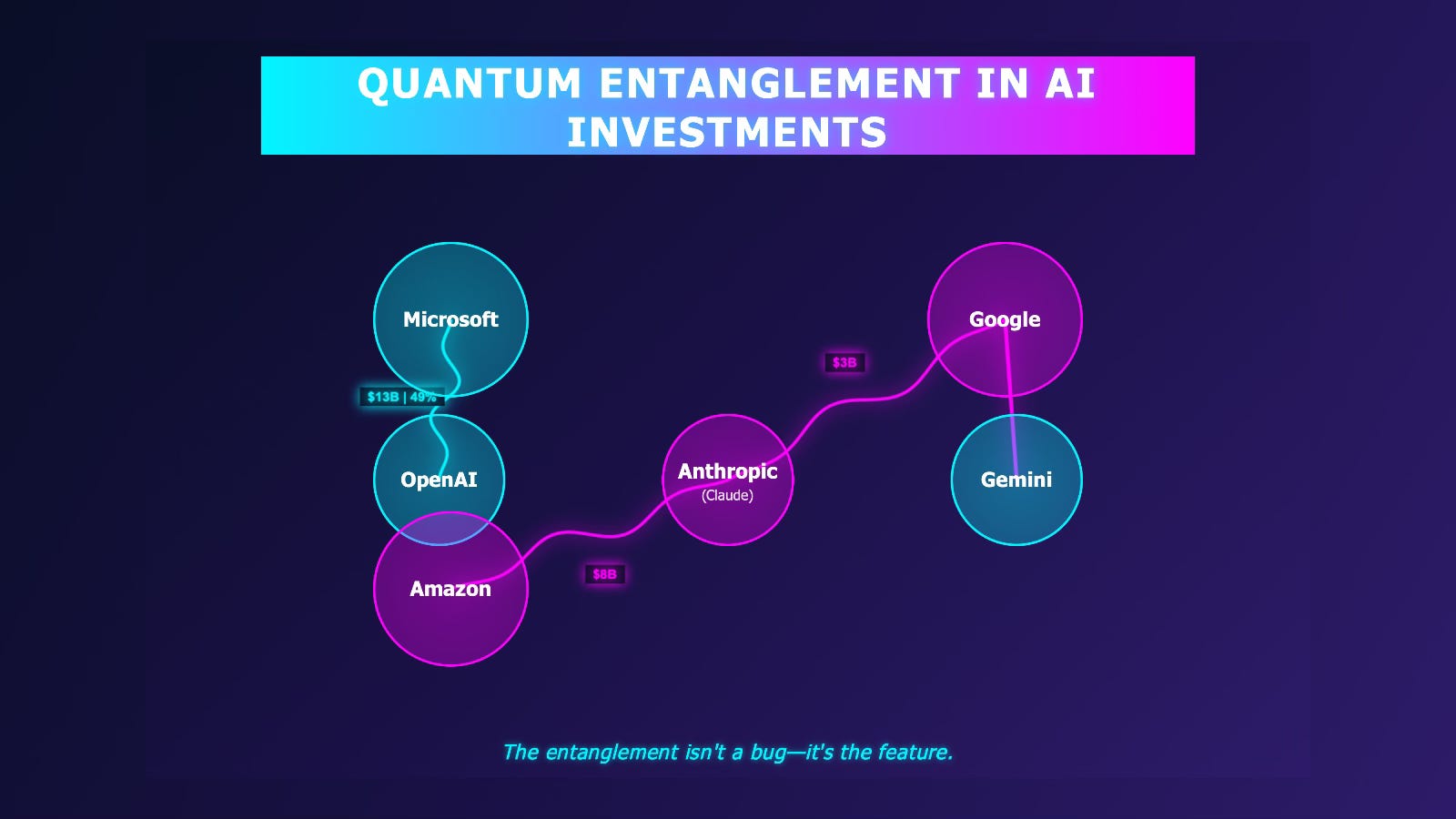
The Web of Investments
OpenAI: Microsoft invested $13 billion, owns 49% of profits, provides all infrastructure
Anthropic (Claude): Amazon invested $8 billion, Google invested $3 billion
Google Gemini: Owned by Google... which also invested in Claude (its competitor)
Microsoft backs OpenAI while building competing AI models.
Google funds Claude while running Gemini against it.
Amazon and Google both invested in the same AI lab.
My first reaction: This is rigged. The competition is fake.
Then I Questioned That Assumption
Is it actually bad that everyone invests in everyone?
Apple and Samsung are fierce competitors—yet Samsung supplies iPhone chips.
Airlines compete while sharing flights through alliances.
Fashion brands under LVMH compete while sharing infrastructure.
Coopetition is everywhere.
More importantly: Does the investment structure change which AI I should use?
No. Claude still codes better for certain tasks. ChatGPT brainstorms better for others. Gemini integrates with my Google workspace.
The product quality is independent of the financial structure.
That’s when the reframe hit me.
This Is Quantum Entanglement
In quantum physics, entangled particles are connected regardless of distance. Measuring one affects the other instantly.
Einstein called it “spooky action at a distance.” It seems impossible.
But it’s not a bug—it’s what makes quantum computers exponentially more powerful than classical computers.
The AI ecosystem works the same way.
Classical vs Quantum Competition
Classical competition: You’re either a competitor OR a partner. Binary states.
Quantum competition: Microsoft and OpenAI are simultaneously:
Competitors (Microsoft builds its own AI)
Partners (provides infrastructure)
Investor/Invested (49% ownership)
Customer/Vendor (OpenAI pays for Azure)
All states exist at once. That’s superposition.
Why Entanglement Is Actually Elegant
1. Multiple Win Conditions
Microsoft wins if OpenAI succeeds (equity grows) AND if it fails (they collected billions in Azure fees either way).
2. Competitive Distance Doesn’t Matter
Google can invest in Claude while running Gemini. If Claude wins → Google profits from investment. If Gemini wins → Google profits from ownership. If both thrive → Google profits from both.
3. System Stability Through Interdependence
If these were truly independent companies:
Each builds redundant infrastructure (waste)
Capital fragments (slower innovation)
Single points of failure (risk)
The entanglement creates:
Shared infrastructure (efficiency)
Free-flowing capital (acceleration)
Redundancy through interdependence (resilience)
4. Faster Innovation
When OpenAI discovers something, Microsoft learns instantly—they’re entangled.
When Anthropic innovates, Amazon and Google both benefit immediately.
Knowledge flows through entangled connections.
What This Means for Users
The entanglement is invisible when you use AI.
You don’t think about who funds whom.
You think: Which AI gives the best output for this task?
That’s the competition that matters.
The financial entanglement actually gives us:
Massive capital → faster innovation
Infrastructure redundancy → reliability
Labs compete on product quality, not funding
Real choice based on merit
The Deeper Pattern
In the universe, everything is connected. Quantum entanglement suggests that at the fundamental level, separation is an illusion.
The universe doesn’t operate on competition. It operates on interconnection.
Stars don’t compete. They exist in gravitational harmony.
Ecosystems don’t have “winners.” Predators and prey sustain each other.
Maybe business is evolving toward the same principle?
Not pure competition (classical).
Not pure cooperation (naive).
But sophisticated entanglement (quantum).
Where companies are competitors AND partners simultaneously.
Where “winning” means the ecosystem thrives.
Where user benefit emerges from structural interdependence.
The Shift in Perspective
I started wanting to pick a side.
I’m ending realizing: Tribalism is the wrong framework.
Some days ChatGPT works better. Some days Claude. Sometimes Gemini.
And that’s fine.
The financial structure is invisible infrastructure—like not caring which power plant generates your electricity.
You care about: Does it work? Is it useful?
The Lesson
I was looking for independence.
I found interdependence.
It’s more elegant.
The AI ecosystem is quantum entangled:
Microsoft, Amazon, Google are simultaneously competitors, investors, infrastructure providers, and partners
All at once, in superposition
Rather than corruption, it might be evolved game theory.
The entanglement isn’t a bug. It’s the feature that makes the system accelerate.
Just like quantum entanglement creates computational power beyond classical physics, business entanglement creates innovation beyond classical competition.
I was looking for the “good guy” AI company.
What I found: A sophisticated system where everyone investing in everyone actually works.
The universe operates on interconnection, not isolation.
Maybe AI investments do too.
The entanglement isn’t a bug. It’s a feature.
What’s your take? Does the entanglement bother you, or do you see it as elegant system design? Drop a comment below.